Monday, November 27, 2006

To get to the university I take the Zamalek shuttle, which departs each half hour from the dormitory, a good five-minute walk from our building. Some days the shuttle gets to the university in little more than ten minutes, but many times there is some significant delay. A taxi, for instance, has stopped his car on a main thoroughfare. He’s talking to a man on the side of the road—perhaps about a fare. Or perhaps the main is his cousin, or his sister’s husband. Their animated discussion could be about most anything. It’s also likely that we will meet some traffic problems at the “stoplights” at the European-styled roundabouts, which usually do little more than flash yellow, yellow, yellow, while a team of police officers give the signals—which amount to little more than curt gestures I still do not understand. Sometimes the traffic police are chatting with one another and forget the deft timing it requires to keep traffic flowing, but motorists are happy to honk and remind them.

And then there is the sheer audacity of the number of cars. It amazes me that this city moves at all, since routinely there are disorganized masses of vehicles trying to fit into increasingly tight bottlenecks, honking their horns (though not necessarily in anger…there is a complex code to honking, such that a honk can come to mean anything from “Fuck you” to “I will see you tonight and yes, yes, I will bring the Balady bread and you shall bring the tea. And peace be to you! To everybody! I love this life!”). I’ve learned since being here that lanes are a luxury—every inch of road space is needed here.

This is what happens when a head of state passes through town.

To give you an image of Tahrir Square, you can call it a poor man’s (I do despise the aptness of that cliché) Times Square. It’s the unofficial center of Cairo, with the famed Egyptian Antiquities Museum, the Arab League offices, the AUC, an always-busy mosque, and a Hardee’s, along with a lot of super-sized advertisements displayed on the roofs of the apartment buildings overlooking the square. There is a large, tiled area populated with park benches, across the street from the university, and a few lame green patches, also decorated with park benches. There is apparently a subterranean parking garage that has been full, with a lineup of vehicles waiting, every time I have passed by it. There are also always some conspicuous tank-looking vehicles that house military police, who are present in and around Tahrir Square because this is the site of many demonstrations, and when demonstrations occur around here, the military gets involved, with the government’s blessing. Such is the nerve center of Cairo.

Now, imagine that all of it has been eliminated. Well, almost all of it. No cars, no pedestrians, no traffic, no honking or Arabic cursing, and, strangely, almost no noise. The square was populated with people, to be sure, but they all spoke in hushed tones, seated at the benches or huddled close to one another. Along all the many streets that converge at Tahrir Square, lined up equidistant from one another, were black-uniformed military officers. Interestingly, they were facing away from the street, facing away from the road that “The Hons,” a.k.a. President Hosni Mubarak, would momentarily be passing through.

I hopped off the Zamalek shuttle and tried to cut across the square and make it to an 11:30 meeting with a student, but I was blocked by an officer, and told by a plainclothesman—there are many here in Egypt (I saw one just today, strutting down the street, a revolver tucked into the back of his pants)--to back off, Jack. So I waited with the whispering Egyptians. They all seemed a little bit nervous. I drank in the beautiful, not-so-polluted-as-usual day, listened to the wind flapping the flags of Egypt that had been placed, I now noticed, at several intervals throughout the square.

For all of this, the president’s passing through was uneventful--which is, I imagine, the purpose of all this hullabaloo. Still, I was struck by the intimodating display of military presence as a sign of respect to the president—or an expression of his power (after all, everybody seemed nervous). A few motorcycles came through, then a convoy of SUVs, then a few more cars, and it was over. Traffic resumed. Almost immediately, the honking started.
* * *
The other night, as M and I were settling in to watch Lord of War on this very same computer I’m now typing into, our viewing was interrupted by some severe honking down below, on the street. Honking is not unusual in Cairo, but we have become accustomed to its particular rhythms and cadences—it’s a confusing code we don’t actually understand, but we understand the noises of that code. What we were hearing was your basic frustrated honking. Naturally, we paused Nicolas Cage in the middle of another dryly delivered line, and opened our windows, and looked down.

Our street is narrow, and at night cars are typically double-parked, so it’s difficult for cars traveling in opposite directions to pass one another. I believe I have written before of the artistry of it. On this night, no artistry to be found. We had two cars facing one another, not enough space on either side for them to steer around one another. Neither car was moving. The car to the left was traveling in the direction least often traveled on our road—though, to some extent, all roads here are equal opportunity roads. But there were no cars behind this car. He was alone. He seemed to be causing trouble for all the cars going in the other direction, not only those cars who wanted to continue on down Bahgat Aly St., but who wanted to make turns at the convoluted and dangerous intersection at the end of our block. None of this was possible. Unfortunately, the ancient police officer whose charge it is to direct traffic at this intersection, or to nap, was long gone. And the guard at the Chinese Embassy, who we watched observing this action, was not interested in involving himself.

Instead, others got involved. A trapped cab driver got out of his car and walked up to the car at the left, who was apparently the one causing all this trouble. But the driver of that car was not to be moved—unless it be forward, we assumed. It was the only answer that made any sense at all. In any event, the taxi driver gave up trying to reason with the driver of the car and went back to his cab, and we didn’t see him again.

Others felt the need to involve themselves. The protégé of our bowaab, a young man who is a bowaab-in-training (we think), tried to reason with him, even trying to move parked cars (they’re usually in neutral, so people can move them as necessary) to accommodate what must have been the driver’s demand for a primo parking spot. But the space in front of our building was not primo enough, it seemed. Some other unhappy drivers left their cars, and in a manner that became increasingly animated, pleaded with the man to move. After all, I could imagine them saying, you are now making life miserable for the occupants of some twenty vehicles. Why not back up and let us through?

Not to be. In fact, the passenger of the car took the liberty of lighting a cigarette and, I imagine, smarting off to one of the increasingly upset people standing all around the car—so, naturally, the man who had been the recipient of the smart comment smacked the cigarette out of the hand of the passenger. The man in the vehicle must have responded with angry, and not smart, words, for the man in the street leaned into the car and began punching the passenger. So the driver finally emerges, ready for action...and promptly finds himself on the ground getting kicked and punched by a couple of other men. I must say that I found this little bit of violence somewhat satisfactory, since, although M and I had been laughing at the complete inanity of the situation, I was also annoyed that somebody would be so hard-headed as to insist on not moving, thus inconveniencing a great many motorists, and delaying my viewing of Lord of War.

I can say that I found the fisticuffs satisfactory because it all turned out to be harmless. As soon as the fighting started, the main perpetrator of the violence ran away—after getting in one more good punch on the passenger—and a bunch of other men—drivers, passers-by, our bowaab-in-training, did all that they could to diminish the violence, calling for peace. Initially, this didn’t work, as the driver returned to his car only long enough to move it diagonally across the road, which served as a symbolic fuck-you to…I don’t know for whom. But whomever it was intended for, there you go. But the man who had kicked him and punched his friend was gone, and the driver was now a fool, and he had no option but to do what he had been urged to do all along. He returned to his car, backed up, and disappeared down the street. Two minutes later, traffic was back to normal. It was like nothing had happened in the first place.
* * *
So sorry to those of you who have checked When in Cairo faithfully these past two weeks, only to find no update. M has offered to write an entry, but it’s been my turn to write, and I haven’t, so all that big heap of blame can go right here. Since the Eid, it has been busier at school, and I have been fighting off another sinus infection (vanquished now, it seems). Anyway, we will do all we can to post a few more times before making our way West for the long holiday to come.

James

Wednesday, November 15, 2006

This just sent from Bryan: http://www.wikihow.com/Regain-Control-of-a-Spooked-Camel

Sunday, November 12, 2006

For a little over a month, I’ve been learning Arabic twice a week through a university tutor. I thought I was just going to be learning to get by – some daily phrases that would help me barter and say hello and carry on a basic conversation. But no! We will learn to write before we can learn to speak! Then you can sound out words, even if you have no idea what they mean! I looked at the traditional alphabet that first day of tutoring and knew there was no hope. A little over a month later, I have made it through 70 pages of my study book and have just learned my first Arabic verb. My ambition to be speaking sentences by December has been doused by reality. I am truly humbled by the difficulty of this language. I feel like a baby, barely literate, being coddled by the nice women in the Arabic department who hold my hands and sugar me up when I am assigned to say something simple to them at the end of my lesson.

Many of the words are gendered. The words go from right to left. The possessive form is as difficult for English speakers as articles are for those learning English. The letters look different depending upon where they appear in the word, and some of them can connect to letters from the right but will not connect with letters coming after. When I make the mistake of trying to connect these letters, my tutor sternly says, “I told you! No link!” He is a stern man who answers his cell phone when I am sounding out words. The impromptu “No link!” has become part of our household lexicon.

I am humbled when my tutor shakes his head and says, “You didn’t study!” after I have spent hours the night before trying to understand my homework. But it is true that I can read now. It takes me twenty minutes to read a sentence, but I can read!

Since I am usually in Zamalek or at the university, I am around people who will answer in English even if I try to speak to them in Arabic. When we went to Bahariya, Samir was the only one we knew who could speak passable English. We also met a little girl who was very good with English. Other than that, with no alternatives, I found myself understanding and speaking more than I actually thought I had retained. Immersion. Of course.

There was one other man in Bawiti who knew enough English to draw a tourist crowd. Bayoumi was the owner of the Popular Restaurant, located across the street from our hotel. The restaurant consists of a latticed area holding the kitchen and one dining table in a building that looks like a cheery machinery shed. Outside are two long tables with colorful plastic chairs. The town of Bawiti is quite dusty, but the tables were impressively clean. The restaurant cooks a set meal a day. You get a pile of bread and several dishes – noodle soup, pickled lemons (an acquired taste) and olives, rice with vermicelli, stewed beans, potatoes, stewed peppers, eggplant, chicken, etc. The Popular Restaurant is also one of the only places in town that serves beer – Sakkara Gold for LE 15. We ate at the restaurant on our first night, and I managed to tell Bayoumi in Arabic that I was a vegetarian. His response gave me enough courage to keep trying out the language.

Everyone in town gravitated past this spot, where Bayoumi held court, drinking Bedouin tea, smooching children, and shouting to everyone he knew. He immediately made friends with J and greeted us loudly each morning when we came outside. He would say, “You come here for dinner? Hotel food no good!” One day as we came back from a walk around town, he sprang from behind a parked truck trying to scare us. Another day, when we had stopped in for a drink, he walked by and smacked us both on the foreheads. When I later asked Samir what the slap on the forehead meant, he said, “It’s OK,” his refrain, so I still don’t know if that old man was being affectionate or really just thought he could get away with smacking a couple of Americans on the head.

Every time Bayoumi saw us, he would yell, “Bush! No good!” and proceed to make a spurty noise to accompany a vigorous thumbs-down. Then he would say, “Americans! Good!” One night he and James ran through a lengthy list of American presidents, and Bayoumi gave his spurt or his thumbs-up. Kennedy! Good! James then listed off the Egyptian presidents he knew, and Bayoumi had nothing but praise. Later, Bayoumi leaned over to me and said secretively, “The American dollar. Very good.” Bayoumi’s photo is below. What you don’t see is that he is holding my hand, and it is very cute.


I have strayed from the main topic, but when I think of Bayoumi I think of the language – he had command over enough English and I had command over enough Arabic for us to have a good time, for us to avoid sitting uncomfortably in silence.

Now I have become addicted to learning Arabic, despite my slow learning curve. I am starting to hear words separated out when people speak around me. Signs and conversations are no longer indecipherable blurs but threads peppered with understandable notions.

I’ll close with a story about getting lost in Cairo this morning. You see, I had to have a blood test and other stuff to get my work visa, and today I was wandering about looking for the lab that turned out to be in a nameless building and in a clinic that made me yearn for the sealed buckets of needles in doctor’s offices at home and for the flawless blood-taking ability of Sonita, a nurse who works with my mom. But I walked right past this clinic without seeing it, just a few blocks from the university, and stepped into another realm. Donkeys, and men smoking sheesha, and more completely covered women.

As I walked by what seemed to be a school, I looked over to an alcove which opened onto a courtyard. Several men were standing around, as usual. When they spotted me, they shouted welcome and ran out to get me and brought me into the courtyard. Clearly, I had looked lost. One of them said, “I can understand you!” in English and then when I started to speak he said he could only speak French but he would take me to the man who spoke English. The man who spoke English looked like a promising fellow, with spectacles and a newspaper, but he too could not understand what I was saying about finding a lab. All of the men were speaking and jostling, and for a moment I remembered the stories about women getting harassed after Ramadan by herds of men. After all, they had brought me in this strange space, and the last woman I had seen was at least a block away. But, seriously, they were wearing old man trousers, and I never felt freaked out. Anyway, suddenly I spoke some Arabic to them, and a little more, and a little more. Each time I said something in Arabic, they cheered. I have never been to a country where attempting to learn the language is so highly praised at the slightest word. Turns out it did me no good because they only understood that I wanted to go to the university and not the university lab. Guy Who Speaks French jauntily put out his arm for me to take and led me toward the university, right back where I had started.

I’ll leave you with a photo from my workbook. You can see my freakish writing next to the neat printed Arabic.

Wednesday, November 08, 2006

Note on J's post below: For some reason comments aren't being allowed on that post, but it looks as if you could leave a comment here if you want.

Sunday, November 05, 2006


Our first evening in Bahariya, Samir and Mahmoud drove us all over the depression, out to Pyramid Mountain, to a stinky salt lake whose shoreline was caked with sulfur-smelling salt deposits, through a grove of date palms (Mahmoud stopped the vehicle, hopped out and grabbed us some dates…which are, incidentally, perhaps the only fruit M does not like). Then we arrived at the part of our journey where we rode camels. All day, Samir had been mentioning this camel ride, intermittently and vaguely, seeming to oscillate between promising us an adventure and telling us that it would be “okay.” Samir’s English is good, but not so good that he could answer our questions about how long we would be on said camels, and where we were going on them. “It’s okay,” he said, and we shrugged and said to ourselves, “He’s the expert. It’s okay!”

We stopped at a small grove in the oasis, where some Bedouins tended a small herd of camels. We saw camels grazing on the grass that grew, improbably, from the sandy dirt. I will say that camels generally are possessed of a facial expression that conveys bemusement. In truth, they are grumpy sons of bitches.

M was, shall we say, skittish about riding a camel; I took this as an opportunity to put her at ease. I think I shrugged my shoulders and made a strange, lippy frown, and said how everything would be “fine.”

Some of you reading this may recall the ill-begotten horse trail ride trough the mountains of Colorado many years ago. This may have been the final vacation for the nuclear family unit into which I was born, and excepting this horse trail ride, it was quite nice. But the horse trail ride was a nightmare; I was a shrimpy, knobby-kneed, hyperactive child, given dominion over his own horse. We got a couple hours into the mountain trail when it began to hail and we decided to return to the stables. This did not stop each of us from taking quite a beating, to get very wet, and for my horse to get so freaked out that it started walking backwards.

I have never felt the comfort of a hotel bed as keenly as I did that evening.

Back in Bahariya, M initially attempts to convince me to take the camel that has been brought for her. It turns out that this camel is just cranky in the way all camels are cranky, and once she climbs aboard, it behaves very well. My camel is a different story. My camel would rather be grazing with its buddies, and it makes every attempt to wrangle free of the rope that is tied around its head, which my Bedouin guide uses to pull the poor fellow away from his buddies (who are now being shepherded into the stable), and out into a desert flat in the direction of Pyramid Mountain.

Here are things I am observing as the camel waddles its grumpy ass across the desert floor. First, the camel saddle is different than the horse saddle. It makes generous room for the emergence of the camel’s giant, hairy hump, which was pressing uncomfortably into my ass. Second, M’s camel is farting a lot. Also, my camel keeps trying to wrangle free of its ties, and every so often it will release a deep, angry bellow and twist its head, its mouth wide open—full with a green foam and pieces of grass. Then, I look to the left. Before us is a large, empty expanse of the desert floor. The day had been overcast—perhaps our first overcast day in Egypt—but now the clouds have thinned just as the sun reaches a mid-point in the sky, halfway between its noontime apex and the horizon. The clouds were indistinct, just a thin, translucent sheet. The sun spread against this gray sheet, widening, brightening—until there was no sun at all, just an ethereal white light. I suppose I now know why and how those trudging through the desert in Egypt could come to believe in such a thing as heaven.

Such were my thoughts when my camel—remember him?—had had enough of my burden and set about, I’m certain, getting me off his back. For those of you who don’t know, the camel sits in the following manner. There is a moment’s hesitation, a warning, as the camel stops what he is doing and prepares to do…something. For me, the quick onset of the realization that something was about to happen was as strong as the nasty breath and flatulence of the camels themselves. Then, abruptly, the camel bent his front legs and dropped to his knees. This put me quickly at a 45-degree angle in reference to sweet, sweet Planet Earth, which loomed, dangerously now, directly in front of me. Seriously, if I hadn’t been holding tightly onto the saddle, forearms bulging and glistening with sweat, I probably would have been tossed, or met with some other equally embarrassing fate. Fortunately, said forearms were indeed pumping, and I me with nothing worse than rope burn on my palms. And a delightful view of the ground. Then the camel sat down the rest of the way, folding its rear legs underneath, and steadfastly refused to move until our Bedouin guide “encouraged” him by slapping him on his long neck with a pole. So, the camel stood again, reversing the process I just described, and pranced all the way to the drop-off point, with Bedouin guide poking him on the haunches with a long wooden stick. Of course, none of this is quite as good as M’s camel refusing to sit at the end of the ride. She had to jump off.

Wednesday, October 25, 2006

Bahariya Oasis – Desert Trip

This is the first post about our trip to the Bahariya Oasis, which yielded all matter of encounters. I’m starting with the second day. After breakfasting on feta, baladi bread, fava beans, and NesCafe in the salmon-walled dining room of the Western Desert hotel, we loaded up in the hotel’s blue jeep and admired the white flames painted on the side. J had requested that awesome jeep from Samir, the manager, and since we were basically the only ones in the hotel, he obliged. We climbed in with Samir and Mahmoud, our driver, who played Arabic music in the car all day and sang nonstop as he whipped around rocks and bumped us through the Western Desert.

Our first stop was an enormous dune not far from town – the culmination of our drive was the jeep picking up speed to make it up to the lower elevation of the dune. A dune is a miraculous thing, but there is not much more I can say except that I collected some beautiful rocks and marveled over the way the sand had smoothed crevices into them.

Next we entered the Black Desert, where the sand was covered with rocks that looked like a layer of pepper from a distance. We stopped at Black Mountain, one of the largest formations, and the rocks here were striking – obviously black, and cut, grooved, shaped by the whims of sand and wind. I climbed about ¾ of the way up the mountain (it wasn’t a big mountain, mind you) until it got too steep for my tennies. J went the other direction, down a path like a spine, picking and tossing rocks.

Again, changes – scrubby plants and lighter sand. Soon Mahmoud swerved off the main road again, and we bumped around for a bit before a large square tank appeared, water spilling into it from a pipe. Next to the tank was a hut, its walls woven with palm leaves, inside of which were mats and woven baskets. When we went to change clothes, I asked Samir if it would be offensive for me to wear shorts, and he said no, "You are free here." Ah, this is where freedom can be found, in a hot spring in Egypt. I wore a huge tee-shirt, in addition to my sprawling mesh shorts, and still I felt a bit risqué until later when an older woman showed up with a bikini bottom sporting her buttcrack. Still, I felt better in my baggy get-up, especially considering the gaze she got from the men folk.

The hot springs were not as hot as one would imagine and smelled of sulfur, but I cannot downplay the fact that this was my favorite part of the day. Water gushed from the pipe and circulated, emptying into a channel that ran to the side and eventually under the palm leaf wall of the hut and through the hut itself. When we pulled up, an old man on a donkey had stopped near the hut, and the donkey was hauling baskets of green on each side of his belly. People were working in a field in the distance, and there was a small group of homes far off comprising a Bedouin village. As we swam, the bikini-ed woman came and left with her posse of Egyptian men, and a group of American tourists pulled up, looked around, and departed.

Then Samir said they would make us lunch. As we sat on the edge of the tank to dry, two little boys walked up and asked for money. J gave them 50p and they seemed thrilled. I tried to speak a little Arabic to them, and they asked me for a pen, which I didn’t have. Kids want pens here. Bring them if you visit. The oldest boy couldn’t have been more than 6; the other was 4 or 5. This was already something we were used to – the kids, everywhere - a subject for another post. The two of them stared, fascinated, until Samir called us into the hut.

Our lunch was set up on a squat round table painted yellow. We sat on the mat-covered floor and feasted on baladi bread, fava beans in tomato sauce, soft feta mixed with tomatoes and cucumbers, tuna (J ate this), chips, Pepsi, and agua. I love me some food. It was so shady and cool in the hut, with the spring running through the channel and the palm tree foundations. When we were finishing up, Mahmoud brought us Bedouin tea in little mugs shaped like pitchers. Indescribably delicious, this tea, with fresh sprigs of mint. Keep in mind that poor Mahmoud and Samir were sitting there fasting, it still being Ramadan for a couple more days. When we finished, we washed our hands and feet in the part of the spring that ran through the hut – there was a bar of soap nestled in the palm tree closest to the water.


We left this tranquil setting and went on to a military stop, where Mahmoud had to give info about himself and say what nationality we were. We had heard from others that you are bound to get a military or police escort if you are an American tourist, and that this escort is like having a big target on you saying, Hey, Look at the Americans!, but we did not run into such trouble on our trip.

We then crossed into the White Desert, another landscape shift, and almost immediately pulled over to see Crystal Mountain, which is more like a hillock made entirely of – you guessed it – crystal. Slivers lay broken over the mountain, but this was the only site with an environmental protection sign, and you know how I am about rules, so none of you are getting crystals. But you may get a rock if you play your cards right.

From here we went off road, eventually coming upon the breathtaking panorama of a valley marking the beginning of the most interesting parts of the White Desert. We stopped here and gazed at the chalklike minerals, rippled like snowdrifts, against the side of the mountains. Then we entered the valley. Some parts of the floor were sheer rock, and Mahmoud took the jeep nearly sideways at the base of formations to stay out of the rock. We entered another large open patch with a white rock floor on which were scattered “flower rocks,” black and round with bulbous protrusions. We stopped here, and Mahmoud, having noticed my penchant for collecting the details of the earth, kept handing me rocks, each one stranger than the next.

The landscape changed again, this time scattered with shrubs and palms, many of them fallen over or dead. Samir said the Bedouins used to live here “200 or 300 years ago.” Samir was a great person to have around, but he was no historian. I soon learned to curb my questions about the history of places and just enjoy them for what I saw. What was clear was that the groves had outlived their usefulness – no water, no human life. We kept passing these old groves and turned onto a rockier landscape, the jeep shuddering as we dodged boulders. Suddenly a real oasis appeared, a small grove of palms with a natural spring. Mahmoud stopped to put water in the jeep. Someone had hung plastic bags of sugar, salt, and flour from the palm trees, which were loaded with colorful bunches of small dates.

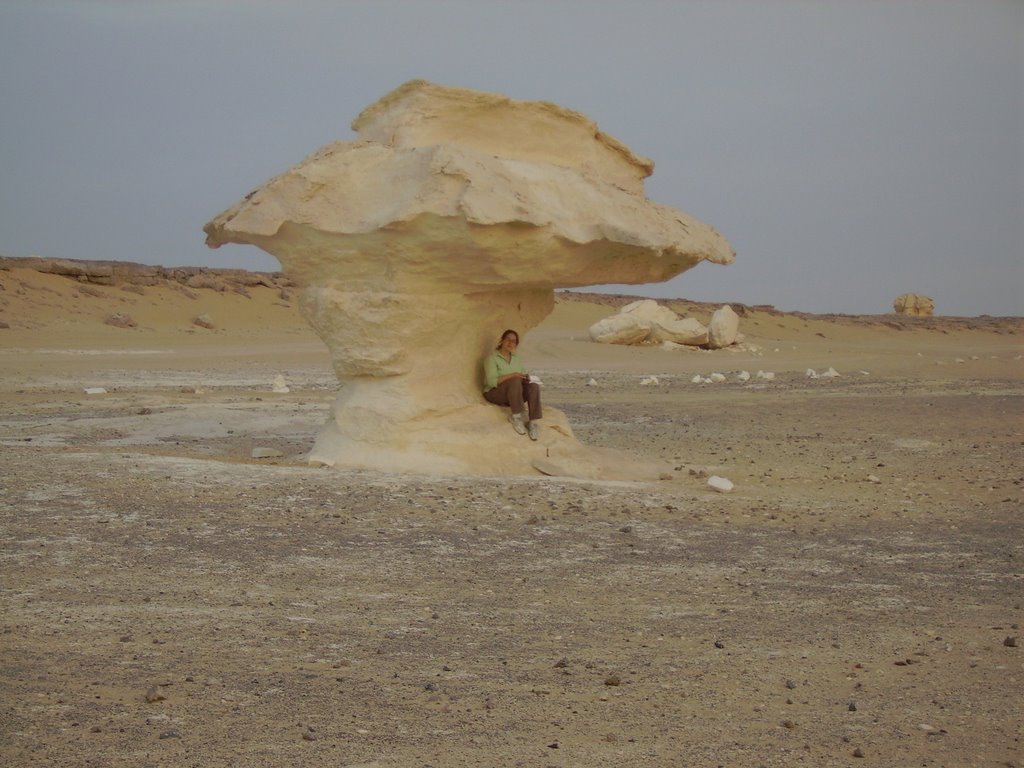
Finally, we reached the most eerie and famous formations of the White Desert – mounds at first, like swollen thumbs dipped in salt and sugar. The first stop: “Ice Cream Valley,” consisting of scooped and swirled formations. Eventually, we came to “The Chicken,” which is two formations – one that looks like a flower or a mushroom, and the other shaped like a small hen clucking up at the flower. Both are situated on a round pedestal of rock as if they had deliberately been put on display.


Indeed, that’s the amazing thing about all of these formations – they look as if they, like the Sphinx, were purposely created and sculpted – lions, profiles of human faces, etc. – when the miracle is that they were simply made from erosion, deposits, wind – the whims of minerals and air. I guess a further miracle is that what we tend to see in these formations is ourselves.

The other day I was thinking about this tendency to see ourselves in inert objects and came upon a passage in a book called The Botany of Desire, in which Michael Pollan quotes Emerson: “Nature always wears the colors of the spirit.” In classical rhetoric, “colors” refer to tropes [this trope info was also revealed to me by Pollan], meaning that we cannot see or experience without preconceived notions, past experiences, or expectations coloring what we see. We think these formations in the White Desert imitate us rather than that we imitate them, or perhaps it goes deeper than imitation. The smallest crevice delights us only in that it seems to resemble ourselves and what we know. Sure, the desert was eerie, but the shapes were us – they could only be us.

All of this (with respect to Emerson, Pollan, DeLillo, and everyone else who has had thoughts such as this a million times before, of course) struck me when we pulled up to a formation and Samir said: “The Horse.” Even though I nodded my head in agreement, I could see nothing like a horse. I saw a large base and a smaller craggy bit jutting from the top. Meanwhile, J scrambled up a formation that seemed a bit big for his britches; nonetheless, he made it and paused like Superman surveying his heroics, chalk smattering his jeans. Then I peered at the horse and saw its long neck and its mane, exactly where I had been looking for it.

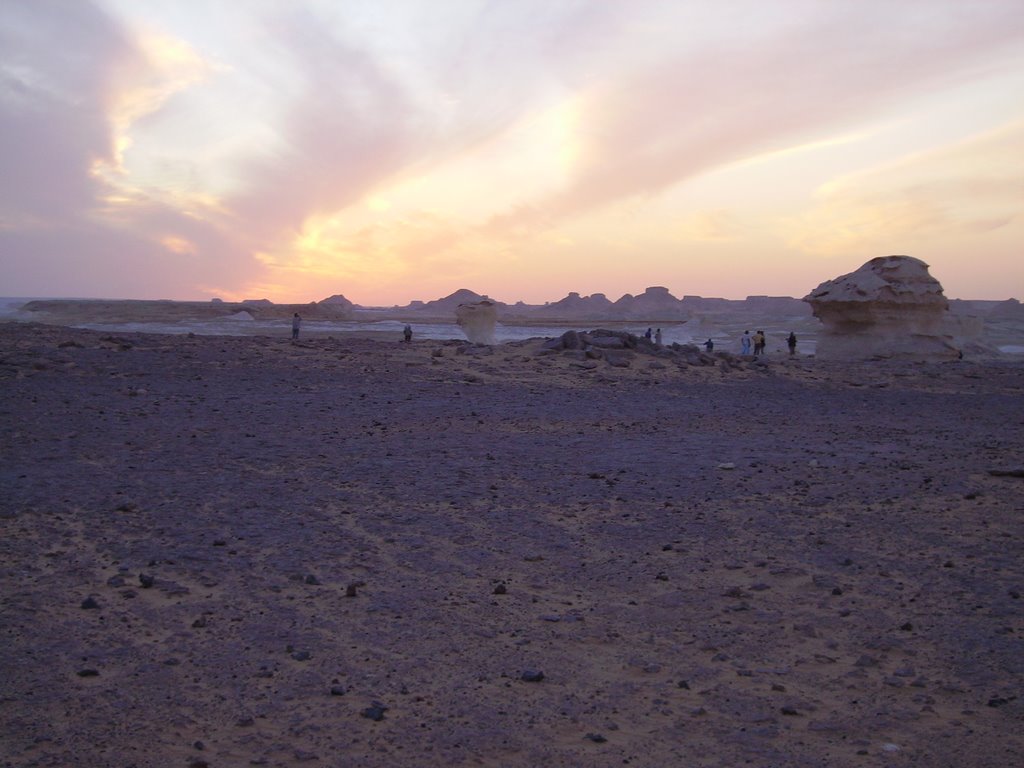
At this point, I must flash forward to the next day, when we watched the sun setting from English Mountain, a cliff with a crumbling rock house where some Brit used to live. The cliff offers a magnificent view of Bawiti and the sun, pink and dropping until it plops out of sight. We took a few pics before the sun actually set but then just watched the splendor, hands wrapped around our knees. As the sun sank, a woman behind us loudly lamented the faulty lighting of her camera, totally disregarding the miracle of the present because she couldn’t record it as a moment in the past.


Let’s go back to The White Desert, though, where the sun is beginning to set just as we pull up to a formation called “The Mushroom,” which I sit under like Alice, watching the way other formations seem to change with the light, surfacing and submerging. Iftar comes, so Mahmoud and Samir chow. Then back to Bawiti and the hotel – a two hour drive.

We met other vehicles occasionally, which each time involved a conversation of lights flicking on and off: Are you there? Yes, I’m here. Do you see me? Yes, I do. Are you sure? You betcha. And one last flicker upon passing. I might add that no one seemed to have taillights. As soon as Samir fell asleep in the front, Mahmoud lit a cigarette. Later, when he tried it again, Samir woke and made him put it out. Their relationship all day was quite fun to watch – Samir telling Mahmoud how to drive, how to do things, Mahmoud talking back – both like biddies, which is the way many men interact in Egypt.

Back in Bawiti, the town bustled post-Iftar – children racing about, men smoking sheesha in open-air coffee shops, grocers selling fruit and spices and opened bags of grain, covered women leading children by the hand. Dusty and crazy, it was a bit much for me after the surreal day, so I headed to the room to shower and sleep. The shower was a head hanging from the wall, basically, so the whole bathroom got wet, but a drain in the floor made it more efficient than it looked.

Anyway, before that, I asked J to get me a lemon soda and some TP from Samir. He did this on his way out to dinner at the Popular Restaurant (worthy of its own post). A few minutes later, Samir and one of the other hotel guys come knocking on the door with a silver tray holding my can of lemon soda, a smudged glass, and a roll of TP. You don’t get THAT from the Hilton, now, do you? Then to bed for me, on the mattress with the red brick foundation, surprisingly comfy after a day in the desert.

Amanda

Monday, October 23, 2006

Back From Bahariya

This is only a quickie. We've returned from Bahariya Oasis and we had a fabulous time. These are only a few pictures of the startling, bizzaro realm of the oasis and parts south. There are many, many more of these and plenty of stories to come. Later. For now, enjoy these.
James


Sand Dune Outside the Town of Bawiti


The Black Desert


The White Desert--just one part of the surreal landscape


Sunset on Some Other Planet

Friday, October 20, 2006


Over the past week, the weather has started to cool. It’s breezier, too, and at night, the wind contains the faintest hint of a genuine chill. Everything is less oppressive; even the sunlight, halogen-like during our initial weeks, has softened, bronze during the day, golden in the evenings. The skies are much clearer now that they have finished burning off the rice fields around the city, and my recent struggles with sore throats and mild sinus infections have disappeared. If this is a taste of winter in Cairo, I’ll have two helpings, please.

Some nights I’ll return late from campus on the Zamalek shuttle, which lets off at the dormitory, a five minute walk from our apartment. I walk up Marashli St. and turn right onto Bahgat Ali, past the Chinese Embassy and the guards who know my face by now. From above, there comes wailing laughter, a high-pitched, mocking call that begins someplace behind me and zooms past, over my head and on down Bahgat Ali. Even though it’s dark, I look up, because I look up when I hear the call of a bird, any bird, much less the chilling cry of this particular bird, which, like many birds here in North Africa, I have not seen or heard before (although the House Sparrow is exactly the same here as one I’ve seen at birdfeeders in Iowa, California, Minnesota and Ohio). But it is dark and the bird flies safely past, mocking the entire way down the block and past earshot, without my seeing it, and I am left to gaze at the wondrous maze of tree branches that meet above the road. They form a thick nexus; the trees themselves emerge from the sidewalks on both sides, leaning out slightly over the road and over me. I think it’s a beautiful sight, but when I first encountered this stretch of Bahgat Ali St., something else tugged at me…a faint recognition, a memory. A likeness to these trees elsewhere. At some point—while falling asleep or waking up, showering, teaching, perhaps during a student conference or a grade-norming session—the memory emerges from behind whatever boulder I have situated in front of it, and I am transported into a brown sedan—although, perhaps my memory does not serve the facts specifically, and I am superimposing my grandfather’s brown sedan from another memory, possibly those times when I would wake for school and he would be there, having risen at his customary 4 am and driven two hours on state routes to have coffee with my mother. His brown sedan in our driveway. What I know is that I am in a car, and he is there, and so is my grandmother. This memory is dislodged from any context and it occurs to me as perfectly distilled. There is nothing in my adult perspective to sully it or diminish it, and isn’t that so often the price of adulthood? There is no past or future action that connects this memory to any other thing. We are driving along a narrow, curvy country road in Kentucky. I know it’s Kentucky because we have crossed the Ohio River into Maysville and left that little city behind. We are surrounded on all sides by a great forest. It is vast. The trees are unlike the trees on Bahgat Ali—they are large, overgrown, wild and untamed. Occasionally a gap will appear in them, and I can look out to one side at the world I have been shielded from, and what I see is empty space. It’s easy to forget the embankment leading down to the Ohio River is just a few dozen feet from the edge of the road. Manchester blinks its blackened eye at us—and is gone. And I forgot about Manchester, just like I forget about the world. All is green and I am protected—from what I don’t know. That’s what I would like to remember. Safety implies danger. Why did I feel so safe?

I’m there now, in that world. I’m standing in the middle of the street and just an instant has passed. I don’t have any declarations to make. I’d like to sit in the back seat with myself while my grandparents drive us through the Kentucky woods and tell myself, whisper it, really, that it’s not so bad. It’s even a good thing, out there beyond the canopy of trees spanning from one side of the road to the other.

James

Friday, October 13, 2006

Today I was awoken by the Friday call to prayer. It was almost noon. I listened to the chanting and singing, the loudspeaker reverberating between buildings – at times, monotonous, at times lilting. I opened the back door and stood on the balcony, collecting laundry off the line, and the strange voice swelled and withdrew. It is still hot here, hotter than usual for this time of year. Yesterday it was 95 degrees in Cairo, while, in Illinois, my parents woke to 30 degrees and snow. Today it is 88, and the skies do not hold those dark clouds from the burning rice fields that have hovered the last few days. This week I finally put long-sleeved cotton shirts to the test. And I was no hotter than usual. See, it means something that I have been brazenly wearing my short-sleeved shirts and plastering my arms with 50 spf. Each time I look in the closet, I think about what my clothing will say about me when I step outside.

I don’t find the clothing issue too oppressive since I am a foreigner; therefore, it seems that I have more power to do what I want. If I am seen as a loose Western woman, there is little I can do to deter that, and if I were to cover my head, I would be a complete poser. But it’s weird to be a girl here. OK, foreign girl. I am almost thirty, but I must use the term “girl.” Anyway, the kinds of looks and words you get from men here have no relation to your age and are in no way to be taken as a badly-planned compliment or offensive forms of flattery because it doesn’t matter what you look like. If you are a woman, fat or skinny, flat-chested or big-breasted, you will get looked up and down and all around like you have never been looked at before.

After coming here, I met a couple of American women who said they suffer endless harassment. They said it tires them; they said they are on the verge of a nervous breakdown; they said they cannot respect this facet of this culture – the obvious inequalities between men and women. I did not quite see their point of view in the sense that I did not have such a strong reaction (which surprises me, but I think not having a strong reaction to a lot around here has kept me sane and laughing), though I wondered about it because both of them dress much more conservatively than I do. I do not dress provocatively (which goes without saying, folks), but I do not purposefully cover my arms and sometimes feel okay wearing capri-style pants and my American tennies that stick out like sore thumbs. And I usually don’t get harassment, only looks, and they really didn’t seem all that bad for a while – simply looks. I was feeling pretty good, actually, like I must look like a respectable lady and the feelings these American women were talking about were just overreactions. I generally walk with confidence and as if I have a busy sense of purpose, and this seemed to be working well for me. (Of course, the fact that I acquiesced to looking down when I walked so as to avoid catching the eye of a man – as that might seem an invitation of some sort – and the way I would defer to J doing the talking even though sometimes I was able to understand something in Arabic that he wasn’t, is in itself self-imposed harassment.) Sure, some soldiers mumbled things when I went by, and I do recall hearing a couple of hisses from men seated in front of embassies, but no one was running out and grabbing my rear or anything, and no one seemed vicious.

Then one morning J and I were looking for a taxi when a man on a bike passed us, turned around, cupped his hand against his man-breast as he looked at me, then pointed at J and gave him the thumbs-up. He also said something in Arabic that was obviously dirty, probably “Nice melons” or something equally repulsive. He kept repeating the cupping motion and his thumbs-up. Why was J getting props for MY assets? Huh? Shouldn’t my great-grandma Glasco, beautifully buxom, get credit for this? I gaped in disbelief while J sternly told the man in Arabic to get the hell away. The only thing that would have made this incident into a good story is if that man would have run his bike into a parked car, flipped over the car, then been pummeled by stray cats. As it was, I was at first astonished that this was happening at 10 in the morning, then, as we finally hailed a cab and the driver spoke pleasantly in English to us, I felt humiliated.

MEN. Men are everywhere. I have never seen so many men. In the morning, I step outside our apartment building. There is the bawaab, squatting against the wall reading a newspaper, or smoking (when it isn’t Ramadan), or washing tenants’ cars, or hosing down the sidewalk, or helping to move paper products from a truck into a dark garage space (we have no idea what the deal is with the paper). Sometimes he pulls my mail out of his pocket. He always says hello.

But he never looks directly at me. This is supposed to be a sign of respect, but for me it is often hard to feel respected when I feel invisible. (Look at J's entry about going into the Ramadan tent and seeing the men cooking. I was there. I was there the whole time. The men welcomed J heartily, shook his hand. I stood on the periphery, and they nodded politely at me and said “welcome,” but it was clear they were uncomfortable and did not want to shake my hand. After all, it was close to prayer time and they cannot go into prayer sullied by a woman’s touch. Later when J took the pictures, I was there, too, and I watched how one man sternly waved away the camera and looked at his wife. Don’t look at her. Don’t photograph her.) But my bawaab, a man with an enormous prayer mark on his forehead, thinks I’m an ok gal.

Keep walking with me, though, past the other bawaabs, past the men lounging in chairs, past the makwagi and green grocer, past the silver-haired policeman who directs traffic at our corner where the street splits oddly, past the soldier leaning against a pole with his gun strapped carelessly on his back, past the next soldier, and the next one, and the man who sits in a chair in front of the Chinese Embassy wearing a suit. Turn the corner, and there is a mass of parked cars, and it seems that they have all been put into neutral so that policemen and soldiers can move them when someone wants to get out. They push each car back, and the cars bump against one another until there is space enough to leave. In front of the student hostel is the shuttle bus. Here are the university guards, in blue, standing clumped on the corner with a husky panting and chained on the sidewalk. All the while, vehicles pass by, men slow, men look. These men are looking at me, many of them. As I pass by the men in front of their businesses, the policemen, the soldiers, the boys on their bikes, the taxi drivers, the deliverymen on their puttering motorcycles, the men wearing Western-style suits, I am keenly aware that they are looking at me, though I usually do not look back. I can feel it. I am every woman on the street.

When I read Mahfouz’s Cairo Trilogy, I was mortified by the fact that one of the main female characters is not allowed to leave her house. Every once in a while, her husband takes her, completely covered, to see her mother. That is it. She does not have friends; she does not go anywhere to pray though she is devoutly religious; her only purpose in life is to serve her husband and children, but mostly her husband. As I was reading, I was aware that the book was set in the early twentieth century, and I remember reminding myself not to think that this was an accurate representation of the Egyptian society I see.

There is an image, though, that I cannot shake, something I saw not long ago near Tahrir Square: a woman completely covered in black, in 100 degree desert heat – only her eyes showing. Her hands were gloved in black. Everything was covered. Everything. She was walking next to her husband, who was wearing a Nike basketball jersey and loose jogging pants. The husband was joyously bouncing their toddler son on his shoulders. They were a young couple.

There is no justice in this. There is no virtue. I’m sorry. There just isn’t.

Most of the women I see here are not covered so drastically. None of my students are. Many of them wear headscarves, quite beautiful, actually, and very stylish. But, even though I see women around me, they sometimes feel invisible.

We are high enough in our apartment building to see into the courtyard and classrooms of the girls’ school across from us. The older girls in the school wear pink uniforms and white headscarves, and the younger ones wear blue and will not be covered until they reach puberty and then decide whether to take the veil, which has all sorts of complicated implications I do not know enough about to discuss. At intervals, the younger girls stand in lines in the courtyard and cheerfully shout the national anthem to the beat of a drum. As they chant, the older girls sit at long tables and work. The windows are always open, even at night. The first morning I heard this chanting, I thought it sounded like a riot had erupted in the streets. Imagine my surprise when I looked down just in time to see the girls be released from the courtyard and run streaming, like ants, back to their classrooms.

Then I saw a young girl trip. Picking herself back up, she held her nose, then started jumping up and down, flapping her hands like little kids do when they don’t know how to deal with sudden, unexpected pain. In no time, she was surrounded by all the other little girls. They were touching her face, consoling her, patting her, hugging her. They never stopped touching her, and they didn’t think to go get an adult to take care of the situation. There was so much care there, so much love. I wanted those little girls to pour into the street with their love.

Where are these little girls most of the time? Where do they go when school is over? Their male peers are dodging traffic in the streets, playing their versions of stickball, hugging each other, being rowdy and sweet.

But I will leave you with this. One night J and I were walking home from the grocery. The streets are dark at night here, and the soldiers stand in the shadows with their guns. Cars flick their headlights on and off just to let you know they are coming. The men are still perched outside on their chairs, or standing in clumps, or walking arm-in-arm together and smoking. I fear none of these men. I am not afraid of the soldiers or their guns. The thing I fear is being hit by a car.

I used to walk down the relatively quiet streets of Minneapolis at night with my keys stuck between my fingers and my hands balled into fists, ready to poke out the eye and scrotum of any man who might emerge suddenly from a bush. I knew that if I screamed, no one would do anything. Too often we sit and wonder if we should do something, or whether what we hear is an actual emergency or just the sounds of the city. We sit so long that it no longer matters. For God's sake, we are told to yell "Fire" instead of "Rape." Let me tell you that in Cairo, one of the largest cities in the world – in Cairo, with its poverty, with its pollution – people will stop and help you. People will hear you scream. They say that you should hold your tongue against verbal harassment because if you raise a ruckus at some hissing man, people on the street will come to your aid. At the very least, they will publicly shame him. If two parties argue in the streets, passersby interrupt their walks to crowd around and convince the two to be at peace with each other, to forgive. They clamor around, like those little girls in the courtyard. They don’t call for the police.

Back to the street, where J and I were walking that night. An older man was crossing past us.

He bent his head and said, “You are welcome here.”

He said it quickly and continued on, waiting for no response.

Friday, October 06, 2006


Hello from a major holiday in Egypt. October 6 is the anniversary of a military victory in the Egypt-Israel war of the 1970s, which brought the Sinai back under Egyptian control—or, as our office mate Ahmed says, back “home.” There is a street named 6th of October St., and even a new suburb near the pyramids called 6th of October City. Can you imagine a town named 4th of July City?

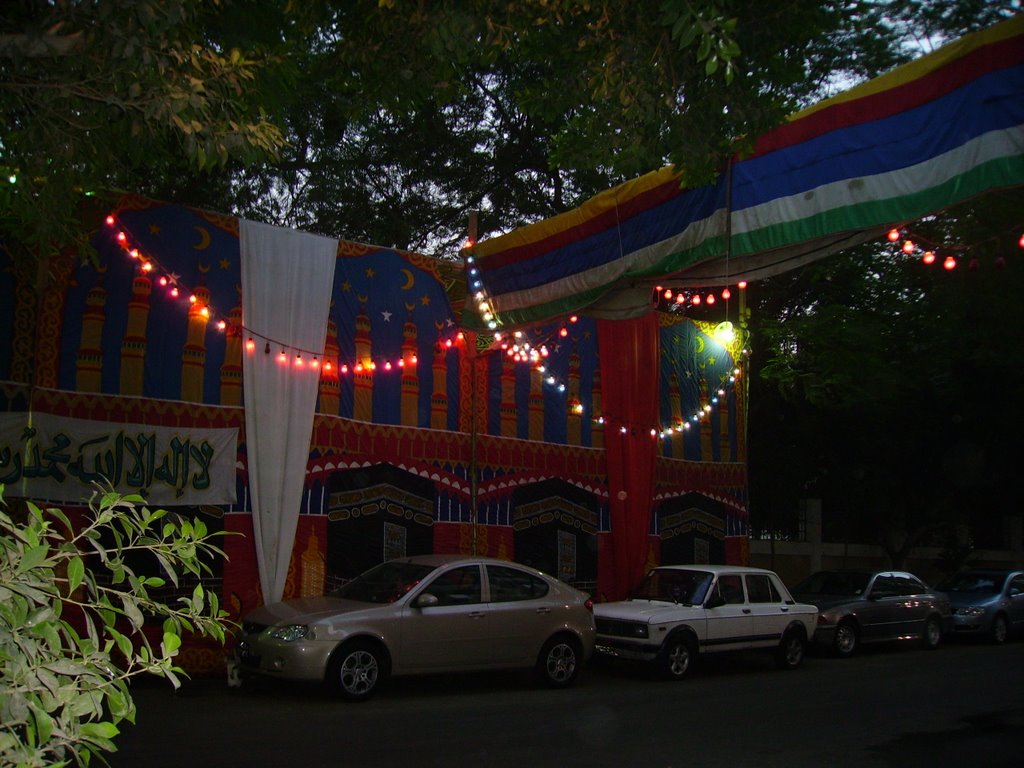
Yesterday afternoon, M and I were on our way to the Alfa Mart when we were waylaid by two—count them, two—letters, both for M, one from her mother, the other from her grandmother. They were sitting on a ledge in the foyer, which I guess counts as our mailbox. We sat down on the front steps to read them, which gave our bawaab the time to sense our presence and motion to us furiously from down the block. As usual, I engaged in a series of gestures meant to pantomime my ignorance. Mission accomplished: bawaab makes the universal “sign of the camera” with thumb and forefinger, then motioned to the sidewalk charity tents that had been erected for Ramadan, just across the street next to the all-girls’ school. Back up the rickety elevator I go to our apartment, where I grab the camera—M is still reading kinds words from Betty—and hurry back downstairs. And bawaab ushers us inside this tent, onto the sidewalk where tables and chairs have been arranged. Such public dining halls are common throughout Ramadan, as they are for the poor who cannot afford a proper meal at Iftar—that magical time of the day when Muslims break their fasts. This also means that there are people cooking these meals, which is generous under normal circumstances, but Herculean when one considers that the cooks are all fasting. Bawaab leads me to a tented enclosure within the larger tent, where a group of men are cooking chicken and fuul (pronounced “fool”) and rice. These are some friendly and, as you can see, photogenic older men, glad, it seems, for the recognition.


Throughout this experience, and the ones to follow, I kept wondering why our bawaab has brought me here. Had he been looking for me all day, or had the idea occurred to him only after he saw us on the front steps? Why does he want me to document this in photographs? M thinks that some Muslims want Westerners to see their religion and its traditions in positive ways. At the very least, I have sensed that many Egyptians feel that their religion has been misappropriated by a violent minority, to serve purposes most Muslims also find abhorrent. Is this what our bawaab is thinking as he guides us “behind the scenes” at the charity tent? Probably not in those words.

Anyway, we return from Alfa Mart just before the Iftar. I can hear on the city-wide loudspeakers the haunting music and low, male singing that represents, I think, anticipation of the moment itself—the blaring voice commencing Iftar. One of the other bawaabs, an older man who wears a security uniform, and who I have never seen standing, waves at us to come down, to eat. Once more, I pantomime: I point to our groceries, point up, point at myself, and then, after pausing, point at him. Then we race upstairs to put away our food, race back down with two bottles of water; we give one of these to the old, seated bawaab, and leave the other inside the charity tent, which is now full with people waiting to break their fast.

We find our bawaab scampering energetically a bit further down the block, out in front of the makwagi shop, where I have my clothes ironed. Our bawaab often scampers energetically, by the way. At this time, he’s busily setting a table that has been put on the sidewalk outside the makwagi. First, the surface is covered in old newspaper. Then, from the bowels of the makwagi shop, among the ironing boards, there appears as if by magic a heaping bowl of rice, a huge plate of beef—a true delicacy here in Egypt—and smaller plates of raw and cooked vegetables. Bawaab and others produce used Aquafina bottles of ice water, soaked all day in lemon—this not only makes them tasty, but also ensures certain death for any roaming bacteria. We take our seats; I’m across from the old makwagi himself, who very intently stares down at the food and waits for the signal. Other than the old man, M and myself, the others (all men) are standing by the table. Just before the Iftar commences, our bawaab places balady bread beside our plates. Balady bread, for those of you who do not know, is like pita bread, only more bittersweet.

Dig-in time is just that: the speakers blared the voice announcing the onset of Iftar, and the men around us poured cups full with lemon water and downed them in a single gulp. Then they tore the balady bread and used it to grab a hunk of meat, or some vegetables, or a handful of rice, and—gulp—disappeared. The makwagi kept motioning to M that she should eat some meat, and we tried, rather sneakily, a technique we learned in the Culture Shock book—M takes the meat, along with other items she will eat, and tries, inconspicuously, to “forget” her meat—or, when the makwagi continually insisted she eat meat (again, any meat is a delicacy in Egypt, very expensive for the average Egyptian, and it’s a matter of pride to not only have meat at one’s dinner table, but to have it in excess), she find a way to pass it off to me. In this way, M got her fill of okra in tomato sauce, rice with vermicelli and vegetable salad, while I consumed a lot of beef and bread. A lot.

From where we sat, we saw no prayers to Mohamed, nothing more than a silent consumption of mass quantities of food, drink and water in a short period of time—quenching the various hungers that had grown throughout the day. Across the street, the charity tent was at capacity; a cab driver stopped his car in the middle of the road and went into the tent for his Iftar meal. Another man appeared from an alleyway, familiar with our bawaab and the makwagi, and grabbed some of the bread by my plate, and dug in. He returned a moment later, smoking a cigarette, which began a ripple effect of smoking. One of the young men produced matches from his front pockets, and before he could open the box, others were already grabbing for it, or pleading for him to hurry. Moments later, after those around us puffed in satisfaction—no smoking during the day at Ramadan—our bawaab scampered up and began to reach into the pockets of his young man, looking for the matches. A moment he later he was among the satisfied smokers.

And then he took us again into the charity tent. Now, it was full with Muslims breaking their fasts. Of course, most everybody was male. There were some girls and a man’s wife in the corner, and bawaab wanted me to take their photographs, but it was clear that these women did not want to have their pictures taken, so, despite our bawaab’s attempts to convince them, I respected their wishes.

I felt odd roaming among these people, expensive camera in hand, photographing the Iftar meal. I wish I’d had the language capacity to explain to them that I wasn’t a tourist from the nearby President Hotel. I wish I could have told them that I live here, at least for awhile, that I am curious about their home and their religion, if only because there is so much talk about it by people back home, people misinformed or ignorant or both. This part of the world is indeed troubled, buckling under the weights of religion, economics and the West. But they do seem like a generous and warm people, effusive and affectionate. It’s not what you’re taught to anticipate. Look at these pictures. They’re only a glimpse of the glimpse we witnessed. What do you see?

James

Tuesday, October 03, 2006

NOTE: Sideways pic fixed. J


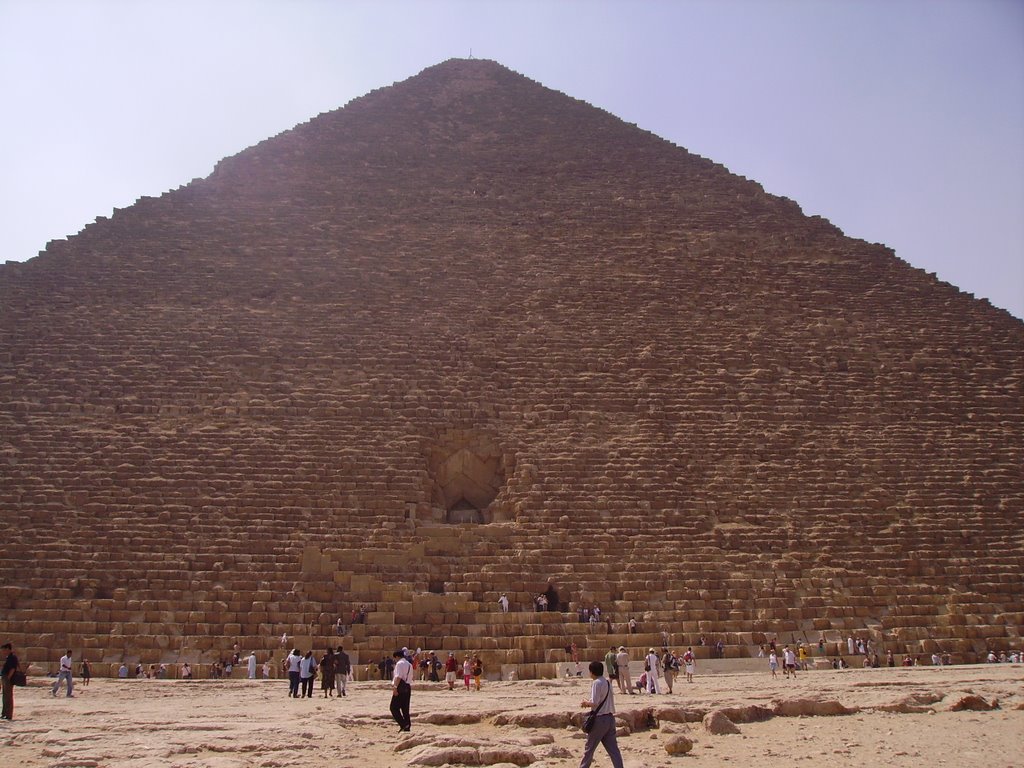
We haven't written in a few days, so I thought I would post some pics from the pyramid trip. This is James and the Great Pyramid of Cheops.

The first pic is when the guy with the pendants was hassling us (see J's previous entry) and wrapped a sweaty turban around my head. My friend Bryan says I look like a New York fashionista in this picture. Yeah. I would say more like a buffoon. It's probably those cataract glasses I got from my eye doctor to wear over my spectacles. Shearn can see the saddlebag purse she gave me before she moved to Brooklyn. You can see my irritation at the man who took this blurry picture, I hope; you can see my finger bent with the message, "Take the damned picture." If you know me, you have probably experienced this look from me. My deepest apologies. But do appreciate the swift and tidy wrap I was given against my will. You know I deserved it.

Amanda

Wednesday, September 27, 2006


Let's take a break from the only standing Wonder of the Ancient World left. Yes, the Great Pyramid of Giza is the only and oldest of the seven ancient wonders. The Arab proverb goes: "Man fears Time, yet Time fears the Pyramids." We were at the foot of that, people. Holy crap.

But let's talk about the everyday. Today I have thoroughly enjoyed washing my clothes. We’ve finally purchased a washing machine (make sure you get a good look at the pinkness of our bathroom in the pic). I just did two loads of clothes and hung them on the lines off our back balcony. Here the clothes, turned inside out, will flap against the sandy building and accumulate Cairo odors. They’ll dry quickly in the afternoon sun.

I am proud of my clothesline! A month ago I was dubious about the thought of hanging my clothes seven stories up. How could my jeans get blown around and stay put with only a flimsy plastic clothespin? I learned how, though, from UmmNadia. UmmNadia is our maid.

Yes, I said it. Maid. Go ahead and flinch. Roll your eyes. Gasp that we have hired a maid.

It seems that everyone (who can afford it) has a maid in Cairo. For one, keeping up with the dust is a fulltime job.

Egyptians, or at least the ones I have observed, are incredibly fastidious about cleanliness. If you look at the photographs of apartment buildings from the outside, they may appear dumpy or dirty. Inside, these apartments are spotless. Not ours, really, since I am guilty of a lot of paper piling. Nonetheless: don’t bring the outside to the inside – this is the reigning idea.

[This is an extreme aside, but I can't help it. Last week as I watched an old white man leaning against a post by the pyramids, and I stared at his sun-reddened belly which he had bared, a belly around which a bright yellow shirt served as an open curtain, a belly on which a round gold chain and mobster pendant dangled, I couldn’t help but momentarily appreciate the way Egyptians cover themselves as a sign of respect.]

There is also the idea that one is actually doing good by employing an Egyptian since the unemployment rate is extremely high. In addition, the Egyptian maid does not consider her job “demeaning” – that’s the word on the street. One of my rich students (they’re all rich, remember), who is the daughter of a member of the Egyptian parliament, informed me yesterday that I should not feel bad about employing a maid. It was hard to swallow this, coming from a politician’s daughter.

Regardless, I fight with myself thinking about whether or not it is OK for me to have a maid here. And it's true that all of the arguments I have against it have to do with the following value -- do it yourself, lazyass. Not that I've ever truly had to work a day in my life, but still -- that ideal is embedded. They say you can spot an American tourist immediately because he will be the only one carrying his own luggage. I don't know how accurate that is. But when we rolled into the airport and people handled my luggage all the way to the apartment, my eyes stayed glued to my stuff. Point? The way Egyptians wrap their minds around the concept of the maid is inevitably different than the way I see it, I believe. I’ve heard, also, that Americans are sought-after employers because we pay more and abuse less. Plus, when we leave here and “fire” our maid, we are expected to give her two months pay beyond the last month she works for us, so that she has a chance to look for another employer.

OK, whatever. So we have a maid. It is still a bit weird after a month. I feel bad sitting in my chair prepping for class and having someone clean all around me. I felt bad the day UmmNadia brought in laundry detergent and proceeded to wash my, er, intimates by hand. I tried to protest, making a repulsed face at my underwear and waving my hands, and she basically pushed me aside and said, Nothin’ doin’. Well, actually, she said something in Arabic that I did not understand, but I got the gist from her spot-on hand signals. We do a lot of pantomiming and giggling at each other. She does make an effort to teach me the Arabic words for certain objects, and then I tell her what they are in English, and we nod and smile and forget the words in five minutes. James started giving her the thumbs-up a lot when she asked something, so now she employs that gesture frequently.

UmmNadia’s name means “mother of Nadia.” So, here, my mom would be UmmAmanda. UmmNadia comes twice a week and spends 3-4 hours in our apartment. When we are here, she says good morning and calls us “doctor” and “doctora.” She starts in the kitchen and washes every dish. She sweeps and mops every floor. She scrubs the bathrooms. She dusts. She wipes down the balcony windows, picks up the rugs and shakes them out, takes out the trash, and moves certain things around if it’s clear we don’t know where we should put them. She picks up and folds errant clothes.

Whenever someone from the university comes to fix something (which seems to be happening a lot: for instance, a funky smell protrudes from one of our toilets at intervals, and they say they fix it, and then the next morning there that stench is, wafting about again, and you have to start asking yourself if it’s just you), she watches them like a hawk. She scolds them if they seem to be dirtying anything or aren’t being careful of the furnishings. A lot of clucking between servicemen and maid goes on. Today I realized that she was telling them that the doctora doesn’t understand Arabic well.

I like having her here when other people are in the apartment. I know this seems weird coming from me, but the service guys prefer to have UmmNadia here too. They are obviously uncomfortable coming into the house without James being present, and that discomfort just displaces itself onto me.

After her first day of working in our apartment, UmmNadia told the dean of our school that James and I “are her children.” I need stuff like that. Yes, indeed, we have a maid.

Amanda

Monday, September 25, 2006

Early in Don DeLillo’s White Noise, Jack Gladney and friend take a drive to visit the world’s most photographed barn. Along the way, they travel a narrow country road overrun with tour buses. When they arrive, they are beset by hoards of tourists, cameras at the ready, snapping photographs. Jack’s friend observes the scene and says, and I paraphrase, that they can no longer see the barn. His point, and it is a good one, is that the barn can only remind them of the photographs they have seen, and not the other way around. The barn itself, awash in the popular culture of tourism, signifies its own image.

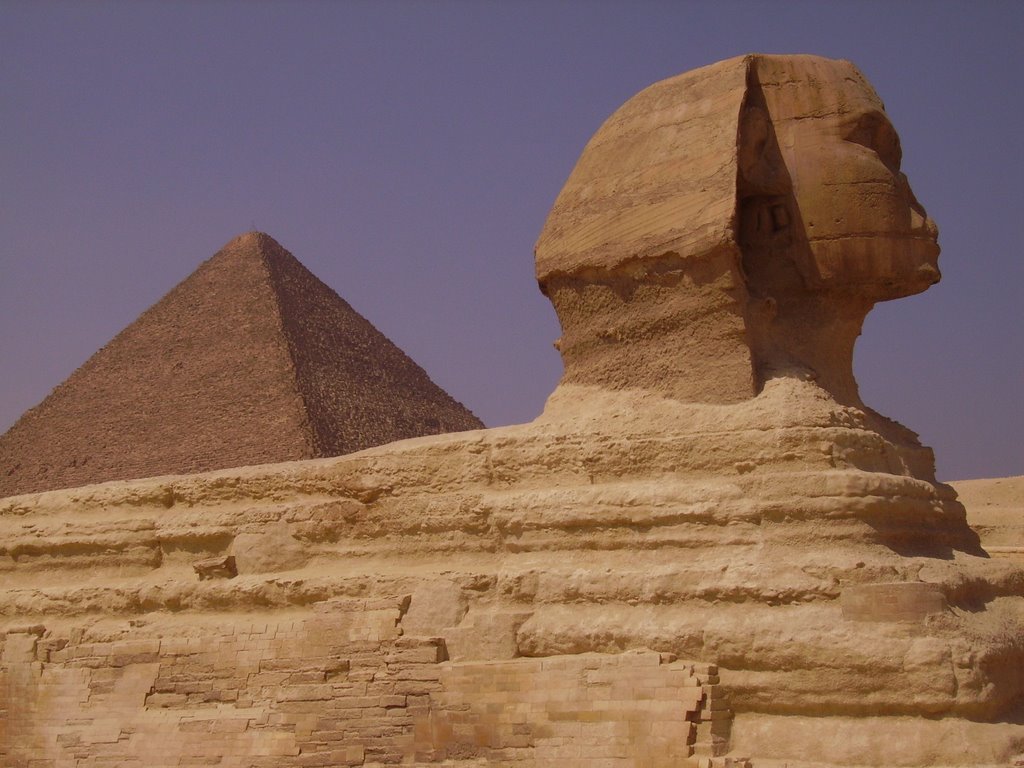
I must say that I was plagued by a certain air of familiarity when we visited the pyramids at Giza yesterday. I felt very much as though I had seen them before. This was not such a big problem for me, though, as I was still awed by the sheer immensity of the structures themselves, and by the absolutely crazy sight of Egyptian hawkers and vendors racing across the rocky desert floor, trying to make a few LE off the rich foreigners.

The grounds of the pyramids are large enough for several parking lots, each large enough for a few dozen tour buses. From one bus you might witness the emergence of a stunned gaggle of geriatric Americans, the old ladies wearing flower-patterned denim hats with a little bow up front, so cute. From another bus might come an extremely enthusiastic group of Asian tourists, hopping gaily across the sandy embankments, posing proudly before the Great Pyramid or the Sphinx, laughing heartily as they view their photographs. You might also see an odd assortment of Europeans ranging from Italian to German to Spanish, clearly distinguished by their garish and scant clothing.

These tourists begin their trek from the bus to the pyramid itself, a trek of perhaps a hundred yards. They are met by a phalanx of vendors, converging from all directions, selling everything from little glass pyramids to plush camels to books of postcards. Their favorite ploy, I soon discovered, was to hand you something and say it was free, a gift for visiting their country. Then, so engaged, they might ask you where you’re from. America? Well then, hi-ho silver it is. No, really, keep the pendant, it is free. Would you like a photograph? Here, give me your camera and I will take. Free!

In one case, a man handed M and I pendants for a necklace, insisted they were free, then wrapped a red and white turban over my head. “You look like Arafat,” he said, at which point I made the mistake of laughing, which encouraged him. He got M to take my picture, then he wrapped the same disgusting, sweaty turban around M’s head, and she, annoyed, also submitted for a photograph. Then he asked for money. No money, I said. “Give me back pendants,” he said, and off he went across the desert with my free gift.

In another case, a police officer, clearly dedicated to his solemn duty, also took my photograph, then wanted money. I said I had none, so he very quickly zeroed in on the Uniball pen in my pocket. So long, Uniball!

Sometimes children would approach, smile cutely, and open like an accordion a booklet of postcards, all connected at the perforated edges. One little girl did this for me. “No thanks,” I say, and she’s gone. Behind me I hear her mutter, “Worthless American.”

It’s worth reiterating that this is not an orderly procession of vendors and hagglers. They have apparently paid a fee and have full access to the site. They appear with little to no warning, striking just as you begin to live your fantasy of quiet, contemplative reflection before the tattered grandeur of the pyramids. That isn’t happening. You have to say no at least three times, and you must be ruthless—they prey on politeness, on our obligation to respond when spoken to. When one is gone, another one will approach, usually from another angle. Sometimes they offer free camel rides—without saying that they will charge 50LE to help you get off the animal, or that they will trek you far into the desert and charge you a bundle to be guided back to civilization.

I don’t really consider the tourist trade much of a detraction from the experience. I actually think it enhanced it. On the ground you have aggressive Egyptians, coaxing money from the pockets of unsuspecting tourists. And all around, you have one of the most fascinating sights one can ever see. The proximity of these juxtaposing situations has quickly become a trademark of Egypt for me. Grandeur and kitsch can be neighbors in the same building.

* * *

As for the pyramids. They are truly stunning, even if you have to do some brainwork for their full gravity to render. Each stone in a pyramid weighs, on average, 2.5 tons, although some of them weigh 15 tons. This means that the largest pyramid at Giza can weigh six million tons. And it’s a marvel of engineering, too: the weight of the structure presses either inward or downward, stabilizing it. One must also remember that it took peasants perhaps twenty years of hard labor to build these structures, which is a testament to tenacity and longevity and purpose. These are startling facts—I remember reading about them in some history class or another. But, for me, the immensity of these facts, these feats, registered fully only when I stood before one of these wonders.

I was particularly thankful for the quality of effective engineering when I made my trek into the Pyramid of Chephren. Not for the claustrophobic at heart. First, you pay 20 LE for a ticket inside. Then, the man by the entrance takes your camera because you can’t photograph the inside (when you depart, the man will return the camera but request, with a sly smile, a tip). For some reason, I expected the entrance to be upwards, where I saw some tourists climbing. In reality, the entrance emerges at the bottom of the pyramid, and you must take a steep causeway to the base of the pyramid. And then you must crouch, and enter. As you may know, everybody, I am not a tall man, but even so the close quarters of the tunnel gave me a moment’s cloying panic. You continue traveling down, down, at the same steep angle at which you entered. I’d say this goes on for fifty yards, and then the tunnel opens into a room that smells of piss. You can stand up and stretch, but because it is so smelly and, suddenly, so humid—the limestone walls are damp, and so are your forearms—you hurry on through and reach another tight tunnel, this time an incline. And you travel another fifty yards. At this point, you might recall the six million tons of rock, arranged just-so above your head. And then the tunnel opens into a large, vaulted room. The walls are graffitied by some British asshole who first discovered this tomb in the 1800’s. On the far end of the room is a stone coffin. It’s open and empty, of course. And the humidity is upon you. A few minutes later, when you finally emerge from the pyramid, the Sahara Desert will feel like a relief in contrast.

My final note is regarding the Sphinx. Perhaps M will add her own impressions. This was the most difficult for me to “see.” I felt very much like I was looking at a photograph; even the photographs I did take look like postcards or pictures from a textbook. This may be owed to the fact that we got very close to the Sphinx, which is not as large as I thought it would be, and that the viewing site is largely devoid of the hawkers and vendors that gave the Great Pyramids, shall we say, a modern flair. It may also be that the great Sphinx of the ancient world looks down upon a Kentucky Fried Chicken, just a few hundred yards away.

Ramadan is upon us.

James


Sunday, September 24, 2006

Wednesday, September 20, 2006

Make sure to check out J’s pics and writing for today (below). I think we must have both been writing an entry at the same time!

Last Saturday we went on a university-sponsored bus trip around Cairo. The city is literally a maze, with narrow winding alleys containing entire functioning communities. Much of the city is designed in wheel configurations, so that neighborhoods are confusing zigzag spokes.

We began in the heart of downtown at the university and traversed various parts of the city. Of great interest to me in this first bit were the Ezbekiya Gardens and a street called Palace Walk, since I have been reading Naguib Mahfouz’s Cairo Trilogy.

I could continue with this patchwork of details, but I think I can narrow this tour down into a few parts that continue to stick in my memory. The first was the City of the Dead, a series of square buildings that are family tombs. You would not know these buildings held the dead unless you were told. It seems that some people live among these tombs, too. Across the road from the main part of the City of the Dead (which is a foreigner’s term, like most of the names we give here) is a vast ring where about nine percent of Cairo’s population lives. Many of these people have come to the city for opportunities that they cannot find at home in the more agrarian parts of Egypt. Most of the people who live here are the garbage collectors. They work in the wee hours of the morning, hauling carts themselves or taking a donkey-pulled cart all the way into Cairo. Before most other people have awakened, the garbage collectors have returned home and are burning the trash that cannot be reused. If you were to awaken very early in the morning, you would experience the acrid smell of Cairo’s burning trash. In October, this burning and the burning of the rice fields, in addition to the general pollution, will produce a dark cloud overhead. Earlier, Prof. Tour Guide had informed us that the more satellite dishes on the roofs of apartment buildings (and I have yet to see a “house”), the richer the people are. There were only a few satellite dishes here. Multiple families spring for one so they can get the public channels.

Indeed, in the first half of our trip, trash and poverty were the themes of the day. Before we passed the City of the Dead, there was a children’s theme park called Cairo Land. Prof. Tour Guide informed us that the park is built on top of an old garbage dump. It is a beautiful park, but at times strange things bubble up from the ground.

Then we began a steep climb into limestone cliffs (called Muqattam Cliffs) that have been quarried for the decorative properties of the rock. Somewhere I read that this limestone was used in either one of the Pyramids of Giza or the Sphinx, but that was in a book with small print, so don't quote me or fault my lack of research right now. I think it was the Sphinx. Let's go with that.

We passed a medieval citadel, and Prof. Tour Guide remarked that this was likely the place where Kevin Costner and Morgan Freeman were imprisoned during the Crusades. As we climbed, we looked down on abandoned government housing for the poor – it was closed down because the poor could not be persuaded to move all the way out there and the government ran out of funds. This area was called Muqattam City. Now, about a decade later, there is a new Muqattam City, fittingly built in the hills overlooking the abandoned government housing. The buildings, many of them as yet unfinished, are among the most lavish in Cairo. (By the way, “new” and “old” in Cairo terms is much different than the way we would see something in youthful America – something considered new here could be a hundred or more years old.)

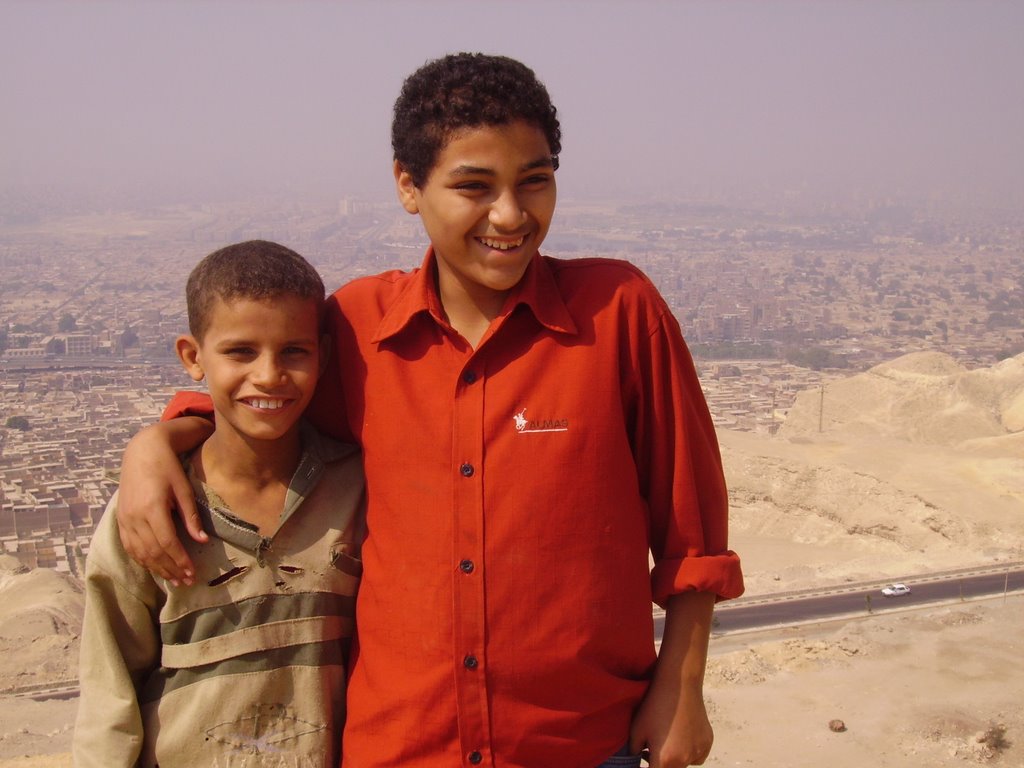
We drove past Muqattam City to the top of the cliffs so that we could get a view of Cairo. See, downtown Cairo, right near where we live, is at the bottom of a huge valley that used to be covered in swamp and water. On a good day, said Prof. Tour Guide, we would be able to see across Cairo all the way to the pyramids. The last good day he knew of, he said, was in 1989. A gigantic haze covered Cairo. We could make out the buildings close to us and could barely see the downtown. I think I’ll appreciate the biting cold air of IL in January. In J’s photo entries, you can see this haze.

Oh, but here’s the great part – we saw this ant scurrying about that had a weird high rear. At this point, I think J was having a better time than me – as I listened faithfully to Prof. Tour Guide, J was hanging out with two little boys who scampered into the group. Their photo is also in his batch.

After this aerial view of Cairo, we drove through Heliopolis, Nasr City, and a string of newer suburbs. (In Nasr City, Prof. Tour Guide, continuing the trash theme, pointed to an unfinished apt. building and told us that it used to be the dumping site of the Cairo University hospital. A man who helped dig the foundation for this building said that what he dug up was terrifying.) The flats got nicer and nicer the further out we went. Yet the city had not succeeded in banishing the poor from these new places. I saw the homeless sleeping on the shady concrete floors of flats that were not yet fully constructed. I saw children in ragged clothes hanging out in the median of the highway, which had begun to look more like the western U.S., with a few Shell and Mobil stations, gleaming with snack shops and car washes, dotted at intervals in the sand. It is the gleaming part that is startling to me now, not the ragged children or the sand. Suddenly there was the costly notion of grass. Foreign greenery. Flat sidewalks. Spraining one’s ankle here would simply be a sign of clumsiness and not an inevitable result.

Then we arrived at the new campus of American University, due to open in 2008, just after the end of our stay in Egypt. The campus is literally on the edge of populated Cairo in a spot called New Cairo, though every new spot in Cairo is called this until it is more officially named. We were given a light lunch and shown a model of the finished campus before heading out onto the 260 acre property. Although the campus tour was as lengthy as the bus ride through parts of Cairo, it was interesting, if only for the fact that we collected the Sahara on our shoes and got to wear hardhats, which were AWESOME. We were also told about the ways in which the campus has been designed so that natural light enters all the buildings. They have made sure to structure the buildings so that there is a lot of natural shade in the open areas and the buildings will throw shade on each other. All of this will of course save on electricity. One skeptic asked, “Yeah, but where are you getting water from?” Ah yes, the Nile. Like the Colorado River, it will make living in the desert hundreds of miles away possible.(J has another photo of palm trees – these line the entryway of the new campus.)

Then we were told about the new faculty housing. We were told about the ways that moving out here would be good for everyone’s health, that it would be safer due to the pedestrian walkways (as opposed to the risk of crossing the street, which we’ve already covered in previous entries), that all the buildings fit North American codes, etc. A lot of faculty members have been dubious about moving out here – some claim that it is as if the university is fleeing Cairo’s infrastructure problems. Sure, it’s safer, healthier, and quieter. (I mean, every class I teach is underscored by fifty minutes of honking). But…we wouldn’t really be experiencing Cairo if we moved out here, would we? Dunno. About this time, J made the observation that the whole trip seemed to have been planned to get faculty out to the campus and convinced about how great it is. Don’t misunderstand me – it is a great campus. The environmental strategies and the fact that the whole thing is being built at once in a massive 300 million dollar effort are undoubtedly impressive.

On our return trip, we drove through Maadi, a richer neighborhood in Cairo that houses a lot of Americans and Brits. Here I caught a glimpse of two of the pyramids of Giza in the distance. This Saturday, as J mentioned earlier, we’ll get a closer look.

Amanda


This weekend we took a guided (and extremely narrated) bus tour of Cairo. We ended up out in the desert at the new campus that is being built, all at once, to the tune of $300 million. I'll write more on this soon, but I wanted to post a few pictures from our journey.

This weekend: pyramids.

James

Monday, September 18, 2006


One thing you’ll notice very quickly in Cairo is the visible police presence. So far, I have been able to distinguish two types of police presence, according to uniform. The first, and most common, are presently wearing their summer whites, head to toe. The shirts of these uniforms are decorated with a sash and other official-looking regalia vaguely reminiscent of Gopher from Love Boat. Apparently, once the weather changes to winter cool, these men will trade in their whites for a different color, and that will be a sad day for me. I like my white-uniformed po-po.

These men appear to be “common” police. Sometimes they perform helpful functions like helping direct traffic—there are very few traffic lights in this city, and those that do operate at, say, Midan Tehrir, do very little to stem the tide of drivers who are intent only on driving to their destination with as little delay as possible. But there is not a necessity for traffic police at every corner, and so most of these police sit around, looking, among other things, bored. You don’t go more than a few blocks without seeing a gaggle of them, arms flung over the rickety iron barrier demarcating their domain, watching the Western women walk by. They hiss at women or they nap. They are boys, they are old men. They fling their arms over their rifles as they wander about their appointed zone, unwittingly pointing the barrel of the gun at disconcerted passers-by (like me). As in the case of one particularly bored young officer, who looked straight down the barrel of his rifle, one eye at a time, these officers might invent new time-consuming activities to quench their thirsty boredom.

The second type of police are the embassy guards, or military police. I’ve been trying to figure out if these guards enjoy an elevated status among their peers. They wear navy uniforms, pants tucked into black boots, and navy berets. As with the “common” police, these uniforms are time-worn, you can tell, faded at the seams and the creases of the pockets. Regardless, these uniforms effectively convey the appearance of military; they also carry old automatic rifles that may or may not be stocked with live rounds, depending upon whom you ask. These young men will most often stare at M as she passes by (but will not attempt to get her attention if I am with her) and will smile at me and say, “Aloo,” when I look at them. These men generally stand at their post outside their assigned embassy—in the case of our most immediate surroundings on Bahgat Aly, that would be China, Serbia, and Oman. Sometimes they are joined by middle-aged men who wear suits all the blazing day long. Occasionally one is sent as a gopher for water.

Interestingly, these blue-uniformed guards appear to be conscripted. How do I know that? you ask. Here is how I know. At various places throughout the city are some beefy-looking paddy wagons. They are blue, armored, with spacious and enclosed beds. The beds are adorned with small, boxy windows covered with a thick grate, behind which you can see the faces of the military police. These seemingly imprisoned military police are guarded by other military police, who also supply them with bread and water. This curious scene confused me for a few weeks before I was informed that young men in Egypt participate in compulsory military service, I don’t know for how long. Young men in Cairo are often sent out of the city, to other places in Egypt—which is, after all, a sizable country—while the country folk are sent here, to Cairo, to perform their service. They are maintained, it seems, in these armored paddy wagons, awaiting their “shift” at whatever spot, embassy or otherwise, they’ve been assigned to. I’m still trying to figure out if they are so kept in order to protect them from what must be the overwhelming sensory delight of Cairo—lots of trouble to be found, even among devout Muslims—or to keep them from running away, lost in the city or back to their rural homes. Their faces in the grilled windows look bored, eager, curious, apprehensive, all at once, complicated by the crossing shadow-pattern of the grill. That certainly doesn’t help me figure out what they think of what they see and hear all around them.

James

Friday, September 15, 2006

I know it's not my turn to post, but J will certainly forgive me.
This is a shout-out to my daddy, who, when I called the Midwest last night, calmly asked me in Arabic if I understood English. Turns out you can go to the Pimsleur's site and get a sample first lesson of all their language CDs.
Yo, Dad!
Here's your shout-out!

Amanda

Wednesday, September 13, 2006


Yesterday morning as we left for school, the bawaab greeted James with a hearty handshake and sort of sideways greeted me, something I am getting used to as the lady of the family. Then the bawaab peppered off a sentence in Arabic to James, and both of us got that dumbstruck feeling that has become familiar.

But a magical thing happened! The bawaab repeated his sentence, and I recognized one word, then two, then the whole assortment of words! He was saying, “You’re going to the university now?” And I said the word for “yes” and translated for James! And rainbows and puppies and Smurfs shone and leapt and sang on Bahgat Aly!

Nah, what really happened is that Pimsleur’s Egyptian Arabic CDs had finally done something for me. As the day progressed and I polished up my newfound confidence, I found myself picking out more scraps of words from people’s conversations. For this day, at least, I did not run away from the language in embarrassment.

So anyway, we were on our way to the university because now both of us are teaching there and not just Mr. James (or Mr. Games, as they call him on his Drinkies receipts). The university is located in Tahrir Square, in downtown Cairo, very near the Egyptian Antiquities Museum where dear Tut could be found if he weren’t in Chicago right now. When we go to Tahrir Square via taxi, we are dropped off, oh, wherever there is a spot in the middle of the aggressive wedges and loops of traffic. Yesterday it was next to a gate with a barely described bit of curb. We walked on the street, weaving around two motorcycles, a bus, and several armed policemen to get to a place where we could actually cross from one curb to the next, and Hello, McDonald’s, home of the McRoyale! We shielded our eyes from the hideous ketchup and mustard colors and crossed again because two army trucks full of men forced into service were parked by the sidewalk, and no woman can escape their hissing and hooting.

Another beautiful thing occurred as we made our way to Falaki, where the Writing Program is housed. The old woman who sits against a dingy wall and sells Arabic candies and Ho-Hos caught my eye, brought her hand to her mouth, and gave me a genuine kissy sign. I felt a spring in my step after that, I tell you.

The above photograph, by the way, is of James in front of The Palace, a university building facing Tahrir Square. This building was originally built in the 1870s for a minister of education, though it is rumored that the Khedive Ismail actually built it for one of the women in his harem. The latter idea is more appealing, especially since the building is now the home of university administration. Once you enter The Palace, you traverse up the marble Presidential Staircase. Each step slants downward enough that I am waiting for the day when someone pulls a lever and all of the steps flatten out so that I slide on my belly to the bottom. Alas. A series of portraits of university presidents (very much like the portraits of priests in the basement of Corpus Christi church in Galesburg) can be found at the top of the staircase. One of the former presidents looks like Johnny Carson. If only. Anyway, that day of the photograph was the first time we came to the university, the first time we took a taxi, the first day, perhaps, that we didn’t feel waterlogged. Maybe the first day that our persistent fight against dehydration ensued.

Yesterday was my second day of teaching. I handed back a short paper my students wrote in the previous class. I had written a few comments on the papers but nothing heavy. After each of my classes yesterday afternoon, a couple of students hung back to ask me, “Was it good?” They had a sincere pleading look that I never got from my Cyclones or my Golden Gophers. “Were there any mistakes?” Coming from the school of checking content or global issues over grammatical or local issues, I tried to explain that I did not “correct” the papers, but if I noticed a consistent error I would be sure to tell them. This seemed a bit of an unsatisfactory response. (Wherever I am, though, I sometimes feel as if teaching students to be self-critical and self-aware is often dependent on my ability to be pleasantly evasive, which has an unintentional negative ring to it.)

In high school, Egyptian students are mainly asked to memorize, so the idea of “critical thinking” which is so lauded in English departments in America is new to many of them, and they are eager to learn it. They (and of course I am always generalizing but bear with this necessity) seem to believe that American students are highly critical. For now, let’s let them believe that.

I was reluctant about taking this job since I was looking forward to a teaching break, and it’s difficult to get used to the writing system at this university because they rely on so many little details and the appearance (deceiving) of less teacher autonomy. But getting away from the typical agonies of English departments everywhere and simply being in the classroom has opened my heart. Escape bureaucracy, and you have the students.

So they call me Mrs. Amanda or Dr. Amanda, and I think it would be wise to not insist that they simply call me “Amanda,” for it seems that this would make most of them uncomfortable. So far they are courteous and respectful, except for the part where they are ridiculously late to class, an acceptable trait in Egyptian culture that the professors at the American style university must be emphatic about deeming unacceptable. No problem here – I laid down the law Amanda-style. We’ll see on Thursday if that actually worked. But many of them are not used to even coming to class. It is common practice here for high school teachers to teach quite poorly so that students stop attending and hire private tutors, who are often the teachers themselves. The teachers can then make more money. So a decent percentage of students here (who come from families who can afford private tutors and the hefty tuition of the university) must train themselves to be students of the classroom again. Ah, if only the poorly paid teachers of America could devise a similar plan.

It is important to note that the tuition at this university is equal to what a middle class Egyptian family would make in a year. Most of this country is poor, so you might guess what sort of kids make up the population of American University. Scholarships and financial aid, you say? Well, from what I hear, two kids from each of the 25 Governorates in Egypt are chosen to attend this university on scholarship. These kids are presumably unable to afford to attend the university. One of the kids must be a boy, and one must be a girl.

Well, here is my entry. Not as exciting as I had hoped but lengthy. This weekend we’ll be going on a guided tour of Cairo, so there should be something more exciting to talk about than the old news of teaching.

Amanda