You pass a fine chocolate shop, a Costa coffee, a garage, a seemingly abandoned building opened for today to reveal the spillover from Seoudi grocery, a rusted sign for a dentist posted on the side of an apartment building, cats and kittens crossing and huddling and scampering and limping away from tires and feet and casting a cold eye, a mostly-dead eye at you if you cluck your tongue or say “kitty-kitty.” They are feral. They are dependent. They are ready to spring. A few of them gather around a styrofoam container filled with water, next to a rotund man in a gallabeya, arms crossed in a chair. You go back and forth from the sidewalk to the road, depending upon the inches between your toes and tires, holes, abandoned piles of brick. There are villas, large and abandoned by everything but vines and small creatures. One old villa is a school, but you can’t see over the yellow wall. There is a bawaab who looks like a gnarled fairy tale tree, and he doesn’t recognize you today, and you don’t think he will ever agree to recognize you.
The men at the green grocer’s are sharing a piece of fruit. The old father figure shows you newly-delivered, enormous radishes, heaves from his chair, stoops, offers them, waits for your nod, then twists off the leaves of one bunch. The rest is tied with palm. Out on the street the first wave of kids is getting out of school, and they buy junk food just like any kids with some change in their pockets, or they buy yams wrapped in newspaper from the guy who pushes his oven around on a cart all day. Little boys dart in front of cars and laugh. Teens kick a soccer ball to each other, back and forth across a street lined with honking cars. The ball smacks against the door of a BMW, once, twice. The driver stares at the car in front of him.
A few minutes later you cross another street, coming out from behind a truck, and nearly get hit by a boy on a bike. He swerves left, then right, whichever way you swerve.
A
Wednesday, February 20, 2008


Sunday, February 10, 2008
The weather was like spring today. The sweater-sporting Egyptians might not say that, but, as I rode back to Zamalek this afternoon in the duct-taped back seat of a cab, I could see the blue sky and smell something...fresh? I walked to Metro, the Western-style grocery store located in the basement of an otherwise dilapidated mall. On the way, I said hi to a bawaab who perpetually parks it in a chair in front of his building. A woman in an abaya was walking in the street. Her companion was a toddler in a torn green sweater who appeared to be too far from her grasp. The boy swerved in front of a car, which slowed before it could hit him. The woman chastised the boy and yanked him closer, then promptly let him go as another string of cars passed.
Across the street from Metro is a new Cinnabon cafe.
I got a chunk of cheddar from the Metro deli. The deli guy who grabbed the block of cheese was being watched by another man in a pin-striped shirt. Deli Guy kept switching his plastic gloves under the critical eye of Pin-Stripe. It's getting a little too clean in there - there have of late been several managerial types lingering and analyzing the situation in the store. Thankfully, a fly egregiously sipped at another wheel of cheese, and no one seemed to mind, and that seemed much better than the thought of ever entering the Cinnabon across the street. You know it's time to flee when the Cinnabon comes to roost.
After leaving Metro, I saw the toddler with the torn green sweater sitting against the wall of the building and chewing on a hunk of bread too big for his mouth. The woman in the abaya was there, too, and a strangely quiet baby had materialized in her arms, and she held out her hands and pleaded for money. A corner store had exploded onto the curb with a giant pink gorilla on top of a stack of...pink stuff. Happy Valentine's Day, everybody! I nodded to the bawaab, still sitting in his chair. He tapped a folded newspaper against his shoulder.
A
Across the street from Metro is a new Cinnabon cafe.
I got a chunk of cheddar from the Metro deli. The deli guy who grabbed the block of cheese was being watched by another man in a pin-striped shirt. Deli Guy kept switching his plastic gloves under the critical eye of Pin-Stripe. It's getting a little too clean in there - there have of late been several managerial types lingering and analyzing the situation in the store. Thankfully, a fly egregiously sipped at another wheel of cheese, and no one seemed to mind, and that seemed much better than the thought of ever entering the Cinnabon across the street. You know it's time to flee when the Cinnabon comes to roost.
After leaving Metro, I saw the toddler with the torn green sweater sitting against the wall of the building and chewing on a hunk of bread too big for his mouth. The woman in the abaya was there, too, and a strangely quiet baby had materialized in her arms, and she held out her hands and pleaded for money. A corner store had exploded onto the curb with a giant pink gorilla on top of a stack of...pink stuff. Happy Valentine's Day, everybody! I nodded to the bawaab, still sitting in his chair. He tapped a folded newspaper against his shoulder.
A
Thursday, February 07, 2008

Thursday, January 24, 2008
"The Palestinians left us with nothing. It's true, they are dear to us, but today, they were like locusts." – Jan. 24 BBC quote from an Egyptian
We saw the soldiers out yesterday - lined up, bulletproof vests, rifles, headgear. But everyone else was proceeding as normal – selling produce, begging, crossing streets with briefcases and ties, honking and gesturing, smiling as we ordered koshary. You wouldn't have known that just a few short hours previously a bunch of Muslim Brotherhood members had staged a nonviolent protest in support of the Palestinians breaching the Gaza border to get simple supplies from Egypt, having had electricity and water cut off by Israel, being punished for the isolated actions of a political group. You wouldn't have known that the Egyptian protestors were chased down the streets, arrested, that batons and tear gas were used. We were at Khan-il-Khalili while this was going on, and we came downtown in the aftermath.
Oh, it's nothing, I said to my parents as we crossed Tahrir Square, as we got redirected through the underground Metro tunnel by a few cheerful policemen so that we wouldn’t exit near the Arab League building, as I asked a vest-wearing soldier if we could walk on the sidewalk, as we boarded a boat and took in the strange quiet of the Nile and passed under bridges brim-full of traffic. Probably just the president passing through, I said. Shows you how used to soldiers I’ve become, even when they’re dressed in the accoutrements of riot suppression.
The season of guests is officially over. I slept until 4pm today after an early morning of seeing off my parents as they continue their journey - a few days in London before returning home. They were not at all like locusts, but they are dear to us.
You'll find photos below of our day at the pyramids (Tuesday), which was rainy. I was disappointed at first, thinking how the photos would not show the beautiful blue sky against the structures, but it actually made the pyramids seem more mystical than usual. Also, we managed to see a bunch of those guys who drive the horses and carts go a little nutty - they were racing around the site whipping the hell out of the horses. The tourist police stopped them, and there was arguing, and one guy got his horse taken away. I think it was a slow day at the pyramids, so they figured - hey, why not race?
That day concluded with a visit to the Museum of Antiquities. From the pyramids, we climbed into a cab seeing its last legs and listened to the driver grumble for an hour and spit mucus, deep from his lungs, out the window. He fell asleep in a long moment of stuck traffic. His window wouldn’t go up, and rain and wind dripped in, and the streets, unprepared for rain, puddled with dirty water. Despite what may seem like a complaint, I was thrilled because it felt like true autumn, a season I really miss. My mom, on the other hand, experienced something I have stopped thinking about, which is how when you are in a grimy cab like that one, you feel as if even your lips need a good scrubbing.
The museum is chock-full of stuff from pyramids and tombs, so full that the extras stored in the basement are literally sinking into the ground and will have to be excavated when the museum moves from downtown to the Cairo exurbs. As the rain poured on the building, we saw it dripping on stairs and leaking on ancient statues. The whole place feels outdated, which is charming. It is badly-lit, and many of the typed, yellowing descriptions neglect to identify the time period of the exhibit. The best part of the museum (and I'm counting the beautiful gold sarcophagi of Tut) is the mummified animal exhibit, where you will see a gigantic crocodile and a monster fish, among other animals – birds, dogs, cats, baboons, and even scarab beetles. Honestly, you feel as if Indiana Jones will come around a corner at any moment, particularly on that dank rainy day.
I'm worried that they'll make the new museum too flashy. I'm worried that, in the quest to entertain and indulge waning attention spans, we will lose a musty feeling of discovery, in favor of flashing lights and touch screens and interactivity. I felt that way upon hearing that the Bell Museum in Minneapolis, with its beautiful and under-lit and sometimes misrepresented dioramas, was going to be moved and some of its exhibits thrown out.
Sure, I would like the statues of Ramses to be protected from the leaky ceiling. But I don't need Ramses to speak to me via computer or something. You sense strangeness and greatness in the Museum of Antiquities without either outdated or updated placards. When you have to squint and bend to the floor as you peer into a dark glass case, you feel like maybe you're the first one to notice the badly wrapped foot of one of the mummies in the Fayoum portrait room. Even the better-lit Tut room lacks order – you push and shove past Russians and Japanese to the sarcophagi and have to read small print upside down to understand which of the two in the room held the mummy.
Anyway, enjoy the photos below. The last one is my favorite.
A


We saw the soldiers out yesterday - lined up, bulletproof vests, rifles, headgear. But everyone else was proceeding as normal – selling produce, begging, crossing streets with briefcases and ties, honking and gesturing, smiling as we ordered koshary. You wouldn't have known that just a few short hours previously a bunch of Muslim Brotherhood members had staged a nonviolent protest in support of the Palestinians breaching the Gaza border to get simple supplies from Egypt, having had electricity and water cut off by Israel, being punished for the isolated actions of a political group. You wouldn't have known that the Egyptian protestors were chased down the streets, arrested, that batons and tear gas were used. We were at Khan-il-Khalili while this was going on, and we came downtown in the aftermath.
Oh, it's nothing, I said to my parents as we crossed Tahrir Square, as we got redirected through the underground Metro tunnel by a few cheerful policemen so that we wouldn’t exit near the Arab League building, as I asked a vest-wearing soldier if we could walk on the sidewalk, as we boarded a boat and took in the strange quiet of the Nile and passed under bridges brim-full of traffic. Probably just the president passing through, I said. Shows you how used to soldiers I’ve become, even when they’re dressed in the accoutrements of riot suppression.
The season of guests is officially over. I slept until 4pm today after an early morning of seeing off my parents as they continue their journey - a few days in London before returning home. They were not at all like locusts, but they are dear to us.
You'll find photos below of our day at the pyramids (Tuesday), which was rainy. I was disappointed at first, thinking how the photos would not show the beautiful blue sky against the structures, but it actually made the pyramids seem more mystical than usual. Also, we managed to see a bunch of those guys who drive the horses and carts go a little nutty - they were racing around the site whipping the hell out of the horses. The tourist police stopped them, and there was arguing, and one guy got his horse taken away. I think it was a slow day at the pyramids, so they figured - hey, why not race?
That day concluded with a visit to the Museum of Antiquities. From the pyramids, we climbed into a cab seeing its last legs and listened to the driver grumble for an hour and spit mucus, deep from his lungs, out the window. He fell asleep in a long moment of stuck traffic. His window wouldn’t go up, and rain and wind dripped in, and the streets, unprepared for rain, puddled with dirty water. Despite what may seem like a complaint, I was thrilled because it felt like true autumn, a season I really miss. My mom, on the other hand, experienced something I have stopped thinking about, which is how when you are in a grimy cab like that one, you feel as if even your lips need a good scrubbing.
The museum is chock-full of stuff from pyramids and tombs, so full that the extras stored in the basement are literally sinking into the ground and will have to be excavated when the museum moves from downtown to the Cairo exurbs. As the rain poured on the building, we saw it dripping on stairs and leaking on ancient statues. The whole place feels outdated, which is charming. It is badly-lit, and many of the typed, yellowing descriptions neglect to identify the time period of the exhibit. The best part of the museum (and I'm counting the beautiful gold sarcophagi of Tut) is the mummified animal exhibit, where you will see a gigantic crocodile and a monster fish, among other animals – birds, dogs, cats, baboons, and even scarab beetles. Honestly, you feel as if Indiana Jones will come around a corner at any moment, particularly on that dank rainy day.
I'm worried that they'll make the new museum too flashy. I'm worried that, in the quest to entertain and indulge waning attention spans, we will lose a musty feeling of discovery, in favor of flashing lights and touch screens and interactivity. I felt that way upon hearing that the Bell Museum in Minneapolis, with its beautiful and under-lit and sometimes misrepresented dioramas, was going to be moved and some of its exhibits thrown out.
Sure, I would like the statues of Ramses to be protected from the leaky ceiling. But I don't need Ramses to speak to me via computer or something. You sense strangeness and greatness in the Museum of Antiquities without either outdated or updated placards. When you have to squint and bend to the floor as you peer into a dark glass case, you feel like maybe you're the first one to notice the badly wrapped foot of one of the mummies in the Fayoum portrait room. Even the better-lit Tut room lacks order – you push and shove past Russians and Japanese to the sarcophagi and have to read small print upside down to understand which of the two in the room held the mummy.
Anyway, enjoy the photos below. The last one is my favorite.
A


Tuesday, January 22, 2008
Karen & Gene - Mediterranean Sea - Alexandria

View of the Mediterranean from the Metropole Hotel

Metropole Salon

Harbor

Little Boy wants his picture - K, A, & J

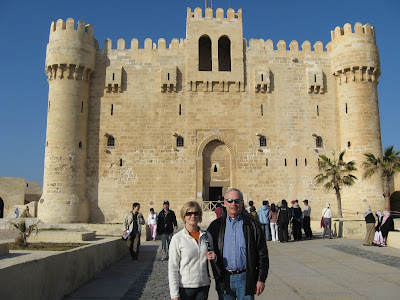
Fort Qaitbey, site of the Pharos lighthouse, one of the Ancient Wonders of the World
Biblioteca Alexandria - Outer Wall

Biblioteca Alexandria - Karen - planetarium in the distance


View of the Mediterranean from the Metropole Hotel

Metropole Salon

Harbor

Little Boy wants his picture - K, A, & J

Fort Qaitbey, site of the Pharos lighthouse, one of the Ancient Wonders of the World

Biblioteca Alexandria - Outer Wall

Biblioteca Alexandria - Karen - planetarium in the distance

Friday, January 18, 2008


Monday, January 14, 2008
So, last week we took this cruise from Aswan to Luxor, and it was really magnificent. The first day was spent with the boat docked in Aswan, awaiting the newest influx of cruise guests. We had an early flight, so we got to hang out all day. Aswan is pretty! We walked a bit around town, finding the souk. B & Ad bought saffron, as you can see below. I’m going to refer to Bryan and Adriana as B & Ad to avoid confusion but also because if you put it together it equals “Bad,” which they are, in the way Michael Jackson meant it back in the day.
View from the ship in Aswan

B & Ad haggle for saffron

That afternoon we went on a felucca ride with two young crewmen, one of whom was so high it looked like his eyes were bleeding. But he was very happy. And not shy about it. We’ve discovered that Upper Egypt and the Sinai are a little more…relaxed. Many of the felucca guys were smoking joints the size of their little fingers, and J was offered some “marijuana,” hard emphasis on the “j.” As usual, the felucca ride was beautiful. We stopped at a place called Kitchener’s Island, which has been turned into a botanical garden. Curiously, they were keeping well-fed cats among the precious birds and plants. B and Ad dipped their hands in the Nile and didn’t get bilharzia.
The sun was traveling ever down as we circled Elephantine Island. A boy, paddling a tiny boat with two pieces of cardboard, called out to us. The side of the boat was painted in blue with “BOOB 2008.” We’ll just assume that meant “Boy of the Observant Brain.” He wanted to know where we were from. After he made a few wrong guesses, I said “Amrikka,” and he started singing “Yippy-yi-yay!” as he maneuvered himself to the back of the felucca and clung on. Then he paddled away.
The next day we visited Lake Nasser and Philae Temple. Then we got corralled into a “special” stop at a perfume factory, where we had to listen to some dude present to us every kind of natural perfume they sold and then offer a special price with some bottles thrown in for “only 75 LE,” the kind of bottles you can get at Khan-il-Khalili for 5 LE. It was stinky in there.
Philae Temple

J at Kom Ombo Temple

We saw some beautiful temples set in picturesque places. You could still see spots of color in some of the engravings and imagine how loud and proud these were in their prime. We visited one temple, Kom Ombo, at night, and we had our first experience docking next to about seven other boats and having to walk through the foyer of each one to get to the dock. We began to see how lavish you can get on these cruises, as each foyer got nicer and nicer, with marble floors or chandeliers.
Ours was pretty neat, too. Witness the crocodile that the guy who cleaned our rooms made from our bedcovers and towels. Actually, B & Ad’s was better because he propped B’s sunglasses on its snout.

We also had quite a few glimpses of the toll the 400 cruise ships on this route are taking on the Nile as they spew exhaust, their oily deposits skimming the surface. Regardless, as B commented upon in the last entry, the Nile remains ever blue.
The final stop before Luxor was the Temple of Horus near Esna. We then docked for the rest of the day at Esna, waiting our turn to cross the locks, which we weren’t allowed to do until around midnight, owing to the plethora of cruise ships wanting to pass through. We got to relax on the top of the boat, where a miniscule swimming pool and a bunch of deck chairs were located. Little kids would call out to us – two girls convinced me to give them shampoo, and, when I left the boat to give it to them, they told me how their parents were sleeping and pointed to the sky. It was a well-rehearsed speech. Whether or not it was true is not important. In the meantime, B and Ad ventured out into the town, and B got offered a number of camels for Ad.
That night was the Gallabeya Party on the boat, where guests were pressured to buy gallabeyas, the likes of which I’ve never seen any Egyptian wear, and engage in weird dancing games. J and I hung out and watched the lock approach, glancing back at the sequined men and women. I had been really excited about the process and then I remembered how long it takes. So I went to bed as the gallabeyas danced on.
We got up and checked out nice and early for the final day at Luxor and our last day with the tour guide. He was a nice young man but not too interested in questions or in people’s eyes wandering away from his presentation. He dubbed our group “Isis,” and he would constantly call out this name. It was a little confusing when we were at the Kom Ombo temple at night and Ad and I started following the sound of “Isis” in the distance and found ourselves near a group of entirely different Isis people than we had thought we were with. Whenever our multi-national group congregated, he would shout," Where's the Indian family?" He also kept asking me if I could get a discount for him at the AUC bookstore, and when I said I didn't have that kind of power, he would say, "You have that power?" This actually reflects something about many of my conversations with Egyptian men, in which they only hear what they want to hear (and often J will say the exact same thing and he is completely heard.) I know that's a stereotype, but it's been bugging me lately.
There was a moment on the bus to the Valley of the Kings where the microphone stopped working. B & Ad, J and I, and an older British woman and her son were all sitting in the middle back of the sparsely populated bus. Everybody else was crammed up front. It didn’t matter – the guide didn’t need the microphone – he was pretty loud.
Then came a typical statement from our guide: “Isis, can you hear me? I don’t know if you can hear me!”
“We can hear you,” I called. We had been hearing him for three days.
“Isis, I don’t know if you can hear me!”
Then he tries to get the middle-back people to move closer.
“We can hear you,” said the Brit woman.
Since I am a rule-follower, my muscles twitched, ready to get up. Nobody else was moving, though, not even the nice elderly British woman, who as good as folded her arms and shook her head. I mouthed, “Should we move?” to J, and he gave me a blank face. Ad's face was all: "No can do." And B wouldn't look at me. This went on for a few more uncomfortable moments. Then the guide gave up. I think I am telling this story because it reveals how tired all of us were of being passively-aggressively asked if we were paying attention. Ad, actually, had developed a temporary hatred of the guy. Sometimes we would hiss “Isis!” at each other.
So we pulled into the Valley of the Kings, and I was prepared to be disappointed, if only because I had been looking at ancient Egyptian stuff for days now and it was all beginning to look the same: engravings of people smiting other people, people offering various goods, gods weighing hearts, etc. You feel bad about that, but it’s all part of the overload. It’s like when we went to the Antiquities Museum and everything you’ve ever seen only in small stolen exhibits in other countries was crammed into one place and then some. By the time we got to Tut’s goods, which are lovely, we were kind of over it. Sad but true. And frankly I am at times a little weirded out by all this plundering of tombs and the women with fanny packs who pay to see it.
Back to the Valley – tombs literally carved into a mountain with lengthy chambers. We didn’t see the mummy Tut, who was recently unveiled there. Basically, our guide said we could see it if we wanted to purchase an extra ticket but we probably didn’t want to see it because it was really nasty because Howard Carter didn’t do a real bang-up job preserving the boy king. Honestly, we didn’t care too much. We especially didn’t care whether or not we saw another mummy when we entered the first tomb and observed the full glory of what we could only imagine when we had noted spots of color at the temples. Almost all of the color in these tombs had been preserved, and it was rich, and detailed, and everywhere. This goes down as the most impressive “ancient Egypt” site I’ve seen. The only thing that was ruining the moment for me in that first tomb was the guy behind me unabashedly clicking his camera, click-ed-y-click, so busy taking pictures illegally that there was no way he could be appreciating what we were seeing. In an ancient tomb in Egypt, I shot him my own little follow-the-rules passive-aggressive look. The moment became brighter when the security guy who had been at the entrance came in and took the camera away and deleted every one of the tomb pictures he had taken. Heh-heh. Look! Just look! You don’t need a picture, little mustached man!
WOW. You just have to see it.
After that, we were taken on another “special” trip to a stone factory or something, and I got a free necklace from a guy who said I had pretty eyes and kept asking me where my “husband” was because Egyptian men often become baffled if J and I don’t stay together in one place once they learn we are buddies. I kept pushing the necklace back because I was certain it wasn’t free. In the end, it actually was. Golly. We saw the displaced homes of people who have been in this area forever – there are tombs beneath their homes that the Egyptian government wants to excavate. There was a big story in Life about this. Then to Hatshepsut’s Temple, much of which has been restored, and a literally five minute stop "for photos" at the Colossi of Memnon.
We spent the rest of our Luxor day on the boat relaxing and awaiting our evening flight. I know we should have been out and about and visiting more temples and stuff, but we had experienced a whole lot of hassling, and this wears you down. (After B & Ad left, I decided I needed some time away from Egypt, which involved two days sitting in my apartment watching my satellite and the first season of Huff and speaking no Arabic except every once in a while proclaiming to myself, “Oh, you live in Egypt? I give you special Egyptian price!”)
At one point, some boys in a rowboat with crude oars came up and begged for money, wanting me to throw it over the side. It was an interesting moment because I was only speaking Arabic to them and told them I couldn’t speak English and they couldn’t seem to figure out where I was from, although they were playing a game with me as much as I was playing with them so who knows what they thought. I held up an orange and one of the little boys held out his gallabeya to catch it, and that was that. They made kissy faces and lewd comments and sang as they rowed away, meeting up with a few other boys in boats.

A
View from the ship in Aswan

B & Ad haggle for saffron

That afternoon we went on a felucca ride with two young crewmen, one of whom was so high it looked like his eyes were bleeding. But he was very happy. And not shy about it. We’ve discovered that Upper Egypt and the Sinai are a little more…relaxed. Many of the felucca guys were smoking joints the size of their little fingers, and J was offered some “marijuana,” hard emphasis on the “j.” As usual, the felucca ride was beautiful. We stopped at a place called Kitchener’s Island, which has been turned into a botanical garden. Curiously, they were keeping well-fed cats among the precious birds and plants. B and Ad dipped their hands in the Nile and didn’t get bilharzia.
The sun was traveling ever down as we circled Elephantine Island. A boy, paddling a tiny boat with two pieces of cardboard, called out to us. The side of the boat was painted in blue with “BOOB 2008.” We’ll just assume that meant “Boy of the Observant Brain.” He wanted to know where we were from. After he made a few wrong guesses, I said “Amrikka,” and he started singing “Yippy-yi-yay!” as he maneuvered himself to the back of the felucca and clung on. Then he paddled away.
The next day we visited Lake Nasser and Philae Temple. Then we got corralled into a “special” stop at a perfume factory, where we had to listen to some dude present to us every kind of natural perfume they sold and then offer a special price with some bottles thrown in for “only 75 LE,” the kind of bottles you can get at Khan-il-Khalili for 5 LE. It was stinky in there.
Philae Temple

J at Kom Ombo Temple

We saw some beautiful temples set in picturesque places. You could still see spots of color in some of the engravings and imagine how loud and proud these were in their prime. We visited one temple, Kom Ombo, at night, and we had our first experience docking next to about seven other boats and having to walk through the foyer of each one to get to the dock. We began to see how lavish you can get on these cruises, as each foyer got nicer and nicer, with marble floors or chandeliers.
Ours was pretty neat, too. Witness the crocodile that the guy who cleaned our rooms made from our bedcovers and towels. Actually, B & Ad’s was better because he propped B’s sunglasses on its snout.

We also had quite a few glimpses of the toll the 400 cruise ships on this route are taking on the Nile as they spew exhaust, their oily deposits skimming the surface. Regardless, as B commented upon in the last entry, the Nile remains ever blue.
The final stop before Luxor was the Temple of Horus near Esna. We then docked for the rest of the day at Esna, waiting our turn to cross the locks, which we weren’t allowed to do until around midnight, owing to the plethora of cruise ships wanting to pass through. We got to relax on the top of the boat, where a miniscule swimming pool and a bunch of deck chairs were located. Little kids would call out to us – two girls convinced me to give them shampoo, and, when I left the boat to give it to them, they told me how their parents were sleeping and pointed to the sky. It was a well-rehearsed speech. Whether or not it was true is not important. In the meantime, B and Ad ventured out into the town, and B got offered a number of camels for Ad.
That night was the Gallabeya Party on the boat, where guests were pressured to buy gallabeyas, the likes of which I’ve never seen any Egyptian wear, and engage in weird dancing games. J and I hung out and watched the lock approach, glancing back at the sequined men and women. I had been really excited about the process and then I remembered how long it takes. So I went to bed as the gallabeyas danced on.
We got up and checked out nice and early for the final day at Luxor and our last day with the tour guide. He was a nice young man but not too interested in questions or in people’s eyes wandering away from his presentation. He dubbed our group “Isis,” and he would constantly call out this name. It was a little confusing when we were at the Kom Ombo temple at night and Ad and I started following the sound of “Isis” in the distance and found ourselves near a group of entirely different Isis people than we had thought we were with. Whenever our multi-national group congregated, he would shout," Where's the Indian family?" He also kept asking me if I could get a discount for him at the AUC bookstore, and when I said I didn't have that kind of power, he would say, "You have that power?" This actually reflects something about many of my conversations with Egyptian men, in which they only hear what they want to hear (and often J will say the exact same thing and he is completely heard.) I know that's a stereotype, but it's been bugging me lately.
There was a moment on the bus to the Valley of the Kings where the microphone stopped working. B & Ad, J and I, and an older British woman and her son were all sitting in the middle back of the sparsely populated bus. Everybody else was crammed up front. It didn’t matter – the guide didn’t need the microphone – he was pretty loud.
Then came a typical statement from our guide: “Isis, can you hear me? I don’t know if you can hear me!”
“We can hear you,” I called. We had been hearing him for three days.
“Isis, I don’t know if you can hear me!”
Then he tries to get the middle-back people to move closer.
“We can hear you,” said the Brit woman.
Since I am a rule-follower, my muscles twitched, ready to get up. Nobody else was moving, though, not even the nice elderly British woman, who as good as folded her arms and shook her head. I mouthed, “Should we move?” to J, and he gave me a blank face. Ad's face was all: "No can do." And B wouldn't look at me. This went on for a few more uncomfortable moments. Then the guide gave up. I think I am telling this story because it reveals how tired all of us were of being passively-aggressively asked if we were paying attention. Ad, actually, had developed a temporary hatred of the guy. Sometimes we would hiss “Isis!” at each other.
So we pulled into the Valley of the Kings, and I was prepared to be disappointed, if only because I had been looking at ancient Egyptian stuff for days now and it was all beginning to look the same: engravings of people smiting other people, people offering various goods, gods weighing hearts, etc. You feel bad about that, but it’s all part of the overload. It’s like when we went to the Antiquities Museum and everything you’ve ever seen only in small stolen exhibits in other countries was crammed into one place and then some. By the time we got to Tut’s goods, which are lovely, we were kind of over it. Sad but true. And frankly I am at times a little weirded out by all this plundering of tombs and the women with fanny packs who pay to see it.
Back to the Valley – tombs literally carved into a mountain with lengthy chambers. We didn’t see the mummy Tut, who was recently unveiled there. Basically, our guide said we could see it if we wanted to purchase an extra ticket but we probably didn’t want to see it because it was really nasty because Howard Carter didn’t do a real bang-up job preserving the boy king. Honestly, we didn’t care too much. We especially didn’t care whether or not we saw another mummy when we entered the first tomb and observed the full glory of what we could only imagine when we had noted spots of color at the temples. Almost all of the color in these tombs had been preserved, and it was rich, and detailed, and everywhere. This goes down as the most impressive “ancient Egypt” site I’ve seen. The only thing that was ruining the moment for me in that first tomb was the guy behind me unabashedly clicking his camera, click-ed-y-click, so busy taking pictures illegally that there was no way he could be appreciating what we were seeing. In an ancient tomb in Egypt, I shot him my own little follow-the-rules passive-aggressive look. The moment became brighter when the security guy who had been at the entrance came in and took the camera away and deleted every one of the tomb pictures he had taken. Heh-heh. Look! Just look! You don’t need a picture, little mustached man!
WOW. You just have to see it.
After that, we were taken on another “special” trip to a stone factory or something, and I got a free necklace from a guy who said I had pretty eyes and kept asking me where my “husband” was because Egyptian men often become baffled if J and I don’t stay together in one place once they learn we are buddies. I kept pushing the necklace back because I was certain it wasn’t free. In the end, it actually was. Golly. We saw the displaced homes of people who have been in this area forever – there are tombs beneath their homes that the Egyptian government wants to excavate. There was a big story in Life about this. Then to Hatshepsut’s Temple, much of which has been restored, and a literally five minute stop "for photos" at the Colossi of Memnon.
We spent the rest of our Luxor day on the boat relaxing and awaiting our evening flight. I know we should have been out and about and visiting more temples and stuff, but we had experienced a whole lot of hassling, and this wears you down. (After B & Ad left, I decided I needed some time away from Egypt, which involved two days sitting in my apartment watching my satellite and the first season of Huff and speaking no Arabic except every once in a while proclaiming to myself, “Oh, you live in Egypt? I give you special Egyptian price!”)
At one point, some boys in a rowboat with crude oars came up and begged for money, wanting me to throw it over the side. It was an interesting moment because I was only speaking Arabic to them and told them I couldn’t speak English and they couldn’t seem to figure out where I was from, although they were playing a game with me as much as I was playing with them so who knows what they thought. I held up an orange and one of the little boys held out his gallabeya to catch it, and that was that. They made kissy faces and lewd comments and sang as they rowed away, meeting up with a few other boys in boats.

A
Friday, January 11, 2008
Maybe some stories later, but for now I'm feeling a bit lazy. Below are some choice pics from the visit of Bryan and Adriana, Minnesota friends. So nice to see them!! So, so nice!! All friends: consider coming. I think we had a great time: Islamic Cairo, Al Azhar Park, the tentmakers, Museum of Antiquities, AUC, Sakkara, Dashur, Wissa Wassef Art Centre, Giza pyramids, and a Nile cruise from Aswan to Luxor, during which we saw Lake Nasser, the Philae Temple, Kom Ombo, Temple of Horus, Valley of the Kings, Hatshepsut Temple, the Collossi of Memnon, and ate a bunch of food. We made them try koshary, which Adriana liked and Bryan didn't, but only because it involved some lentils and chickpeas. We finished the last day bargaining at Khan-il-Khalili.
J, Adriana, and Bryan at Bab Zuweila in Islamic Cairo

Bryan and me at the Great Pyramid

Bryan and Adriana's America's Next Top Model Audition - Pyramids of Giza

View from Philae Temple near Aswan

A
J, Adriana, and Bryan at Bab Zuweila in Islamic Cairo

Bryan and me at the Great Pyramid

Bryan and Adriana's America's Next Top Model Audition - Pyramids of Giza

View from Philae Temple near Aswan

A
Tuesday, December 25, 2007
It’s Christmas. We write. I watch the Power Puff Girls and trudge through Pale Fire, which is interesting, then not, over and over. We call people at a dollar a minute. Not bad. Or people call us. We say hi; we listen to kids in the background. Kids who are talking, burbling new words and roughhousing, or settling into adolescence. Across the street the girls are in school, in recess. The last sheep in the yard still bleats. Will anyone eat her? We decide to get out. We go to a restaurant with clouded windows called L’Aubergine. I have “trio of crepes” – one mushroom, one spinach, one broccoli – and a Sakkara beer. J has chicken teriyaki and a weak screwdriver. New Age music in the background and colorful walls. Mostly Europeans here, a mishmash of language. The waiter says “Happy Christmas.” Then to the vegetable seller, who has a fresh batch of asparagus and spinach. He is wearing flip-flops too big for his feet. The air is crisp. No Christmas music, no snow, but cheerful out here. Many restaurants have put up little trees and tinsel. The streets are less populated, so we can feel something, maybe something from the past that we wouldn’t recognize. A little boy, maybe four, wears a gallabeya and sits on the hood of a car. The gallabeya puddles around him. He swivels his head and softly says hi and blinks and smiles. We swerve into a store that sells rugs and bedding. An old man in a brown sweater says, “handmade, handmade.” We buy.
A
A
Wednesday, December 19, 2007
Everyone keeps saying they’ve never seen the pollution this bad. Indeed, it’s something I’ve noted more often in my second year here as a palpable sensation in my lungs and sinuses. It’s not just a disturbing black cloud emitted from the public bus anymore. It’s the realization that we are inside of that disturbing cloud all the time, at the bottom of a valley that’s getting less and less fertile, and that what is outside manifests in the body. Yesterday morning it looked as if someone had shaken a sack of flour over the city. It is on days like these that I sense hours of ginger tea and decongestant ahead.
We bought an air purifier the size of a TV from the ubiquitous Radio Shack, and this has helped. The instruction manual says to clean the filters every two months, depending upon where you live. Here? Two weeks is pushing it.
When the wind pushes away the pollution, and the sky comes through, it’s unbelievably beautiful. If you climb the Muqattam hills, you will see the black cloud below that is Cairo, and above and away, all is pristine. People, even our university, are pushing out and out, pulling the Nile with them in sleek new piping – people who can afford it.
*
Today is the first day of Eid Al-Adha, a Muslim holiday which appreciates Abraham’s (Ibrahim’s) willingness to sacrifice his son to God. Oh, the myriad ways in which Muslims, Jews, and Christians are actually kind of the same…
In the last week, sheep, goats, or cows started appearing on the streets, getting hauled in the backs of trucks, their eyes looking rather dead even as they blinked. The beggars suddenly were holding strangely quiet babies, swaddled in the streets. More carcasses than usual hung in the open air in front of butcher shops, those skinned marbled hunks of meat with still-hairy tails hanging down. Suffice it to say I’ve seen way too many dead buttholes. In the usually empty yard behind our apartment building, three sheep appeared, waking us up a few mornings ago with their bleating. One of them had red wool and a white head. These sheep get fattened before slaughter. Even Alfa, a hodgepodge department store, had a penned goat for sale.
The animals get sacrificed – each family keeps 1/3 of the animal and gives the rest to the poor. Yesterday James stumbled upon the bawaab, makwagis, and various guys who hang out on our street just as they were finishing up the slaughter of a cow on the corner. Bloody street and sidewalk, a sheaf of skin, entrails pulled and squeezed. Our bawaab was wearing tall rubber boots and a sweatsuit rather than his usual gallabeya.
This morning I woke to the sound of a bleat and went to the back porch to watch a man, followed by two little boys, lead the red-wooled sheep away. All three sheep had one front leg tied by rope so that they had to hop; the other two sheep were also tied together, and they bumbled around the dusty yard. I’m sure they could smell what was coming.
A
We bought an air purifier the size of a TV from the ubiquitous Radio Shack, and this has helped. The instruction manual says to clean the filters every two months, depending upon where you live. Here? Two weeks is pushing it.
When the wind pushes away the pollution, and the sky comes through, it’s unbelievably beautiful. If you climb the Muqattam hills, you will see the black cloud below that is Cairo, and above and away, all is pristine. People, even our university, are pushing out and out, pulling the Nile with them in sleek new piping – people who can afford it.
*
Today is the first day of Eid Al-Adha, a Muslim holiday which appreciates Abraham’s (Ibrahim’s) willingness to sacrifice his son to God. Oh, the myriad ways in which Muslims, Jews, and Christians are actually kind of the same…
In the last week, sheep, goats, or cows started appearing on the streets, getting hauled in the backs of trucks, their eyes looking rather dead even as they blinked. The beggars suddenly were holding strangely quiet babies, swaddled in the streets. More carcasses than usual hung in the open air in front of butcher shops, those skinned marbled hunks of meat with still-hairy tails hanging down. Suffice it to say I’ve seen way too many dead buttholes. In the usually empty yard behind our apartment building, three sheep appeared, waking us up a few mornings ago with their bleating. One of them had red wool and a white head. These sheep get fattened before slaughter. Even Alfa, a hodgepodge department store, had a penned goat for sale.
The animals get sacrificed – each family keeps 1/3 of the animal and gives the rest to the poor. Yesterday James stumbled upon the bawaab, makwagis, and various guys who hang out on our street just as they were finishing up the slaughter of a cow on the corner. Bloody street and sidewalk, a sheaf of skin, entrails pulled and squeezed. Our bawaab was wearing tall rubber boots and a sweatsuit rather than his usual gallabeya.
This morning I woke to the sound of a bleat and went to the back porch to watch a man, followed by two little boys, lead the red-wooled sheep away. All three sheep had one front leg tied by rope so that they had to hop; the other two sheep were also tied together, and they bumbled around the dusty yard. I’m sure they could smell what was coming.
A
Sunday, December 16, 2007
From the novel The Map of Love, by Ahdaf Soueif:
"And yet - I sit here in my room at the Shepheard's Hotel possessed by the strangest feeling that still I am not in Egypt. I have sat on the Pyramid plateau and my eyes have wandered from the lucid blue of the sky through the blanched yellow of the desert to the dark, promising green of the fields. I have marvelled at the lines between blue and yellow and then again between yellow and green - lines drawn as though by design. I have climbed the Pyramids and danced at the Khedive's Ball. I have visited the Bazaar and the Churches and the Mosques and witnessed the procession of the Religious Orders and played croquet at the Club at Ghezirah. I know a few words of the language and I can mark many streets by the houses of people with whom I am now acquainted, but there is something at the heart of it all which eludes me - something - an intimation of which I felt in the paintings, the conversations in England, and which, now that I am here, seems far, far from my grasp."
"And yet - I sit here in my room at the Shepheard's Hotel possessed by the strangest feeling that still I am not in Egypt. I have sat on the Pyramid plateau and my eyes have wandered from the lucid blue of the sky through the blanched yellow of the desert to the dark, promising green of the fields. I have marvelled at the lines between blue and yellow and then again between yellow and green - lines drawn as though by design. I have climbed the Pyramids and danced at the Khedive's Ball. I have visited the Bazaar and the Churches and the Mosques and witnessed the procession of the Religious Orders and played croquet at the Club at Ghezirah. I know a few words of the language and I can mark many streets by the houses of people with whom I am now acquainted, but there is something at the heart of it all which eludes me - something - an intimation of which I felt in the paintings, the conversations in England, and which, now that I am here, seems far, far from my grasp."
Friday, November 30, 2007
Last weekend, we finally made our first foray out of Cairo since arriving back in the city in August. And not a moment too soon: as busily as we have been marching toward the end of our 3rd semester here, I have still had time to notice the persistent fog of haze clinging over the city. Is it me, or does it seem worse this fall than it did last year? It didn’t help that hot temperatures lingered into November, packing in the particles. Also not helping: leaded gasoline, the burning of rice fields and garbage, living in a valley.
And yet, what plagues me about life in Cairo implies one of the tremendous benefits of leaving the city. In Egypt, where everything is out of proportion, where most people live on a thin strip of land, leaving the city means leaving behind the stink and the hazy air. Things seem unspoiled. The air is crisp and clear, the sky deep bottomless blue, the sun golden on the craggy, sea-side mountain face. Did I mention the clean air?
Our trip took us a couple of hours out of Cairo, along the Gulf of Suez with its persistent ships approaching or departing the Suez Canal. We visited two very old Christian monasteries, the Monastery of St. Anthony (now with adjoining cave) and the Monastery of St. Paul, the pimped-out Vegas strip of monasteries. These monasteries are still active, populated by many devout and stylish monks who wear black habits and skull caps, and long beards—who also use their BlackBerries to communicate with the outside world and wear fashionable, coordinating sunglasses.


The saints after whom these monasteries are named escaped religious persecution in Cairo and Thebes back in the day, settling in the rugged mountains of the Eastern Desert, a few kilometers from the Red Sea. Following their deaths (of old age), the monasteries were built in their names and have continued to thrive, despite many assaults from Bedouins over the centuries. These monasteries, in fact, have the look of an ancient fortress. Both are protected by high walls, and each has at its center an ancient “keep,” surrounded a moat, where the monks would retreat if their outer walls had been breached.
Today, these active monasteries are protected by the Egyptian government—which I admire, given that the country is now overwhelmingly Islamic. There is one road in to each of these monasteries, and our bus had to stop at a checkpoint, manned as usual by some of Egypt’s finest. The roads extended for miles into the desert, to the foot of mountains where the St. Anthony and St. Paul kept safe in their lifetimes. Inside their walls is a thriving and largely self-sufficient community of Christian monks, giving tours, driving construction equipment, tending gardens, baking bread, splashing unsuspecting agnostics with holy water from the springs that sustained these monasteries for so long.

I have visited some historically significant Christian churches and cathedrals in Europe and America, but I found my sense all things Christian heightened at these places. It was like entering another world, one half-familiar to me. Gone were the minarets, the rounded structures, the open air prayer rooms, of Islamic architecture, which (of course) dominate the landscape throughout Egypt. Instead I saw icons of the saints after whom the monasteries are named, of Jesus himself. I saw it next to Arabic script, as I heard Arabic spoken around me, in the soft, compliant voices of the monks whose homes we were visiting. I sensed, as these monks must have, that these monasteries were safe havens now, protected, their place in Egypt secure. I found myself admiring the monastic life I saw around me, so different from the bustling city just two hours away. Even though the monks buy olive oil from the grocery rather than press their own olives, even though they drive moving equipment and depend upon generators to provide one fundamental of modern life—electricity—their lives are not significantly different than those of monks who have lived at these monasteries for generations dozens of generations. I admire people who live the lives of their convictions, even if I don’t share those convictions myself.

With one caveat—the Monastery of St. Paul. The place itself is ancient, but it is fairly bursting with pilgrims and tourists, much more so than St. Anthony’s. When we pulled up to St. Paul’s, we were confronted with a large but poorly-conceived parking lot built on a hill, which was already half-full with tour buses. As we approached the entrance to the monastery, we passed a roiling gift shop that sold such things as toy machine guns (one little boy had the gall to point and shoot at me, but couldn’t keep firing long enough for me to snap a photograph) and loud religious-esque music blaring from speakers. Inside, we had to squeeze among other tour groups as we visited St. Paul’s relics, gathered into a child-sized coffin covered with a sheet of clear plastic—and the ancient spring, the presence of which our monk guide claimed cannot be explained.
The parking lot at St. Anthony’s, on the other hand, was virtually empty. When we climbed the modern stairwell up the mountainside, ascending to the cave where St. Anthony retreated from persecution, I had to stop a few times, calves burning, lungs belching forth the sediment of three uninterrupted months in Cairo. After reaching the top and squeezing into the narrow cave where the man had lived, after collapsing on the rocks and breathing in the fresh, thin air, I looked over the precipice where we all sat and, for the life of me, I couldn’t see another living soul:

James
And yet, what plagues me about life in Cairo implies one of the tremendous benefits of leaving the city. In Egypt, where everything is out of proportion, where most people live on a thin strip of land, leaving the city means leaving behind the stink and the hazy air. Things seem unspoiled. The air is crisp and clear, the sky deep bottomless blue, the sun golden on the craggy, sea-side mountain face. Did I mention the clean air?
Our trip took us a couple of hours out of Cairo, along the Gulf of Suez with its persistent ships approaching or departing the Suez Canal. We visited two very old Christian monasteries, the Monastery of St. Anthony (now with adjoining cave) and the Monastery of St. Paul, the pimped-out Vegas strip of monasteries. These monasteries are still active, populated by many devout and stylish monks who wear black habits and skull caps, and long beards—who also use their BlackBerries to communicate with the outside world and wear fashionable, coordinating sunglasses.


The saints after whom these monasteries are named escaped religious persecution in Cairo and Thebes back in the day, settling in the rugged mountains of the Eastern Desert, a few kilometers from the Red Sea. Following their deaths (of old age), the monasteries were built in their names and have continued to thrive, despite many assaults from Bedouins over the centuries. These monasteries, in fact, have the look of an ancient fortress. Both are protected by high walls, and each has at its center an ancient “keep,” surrounded a moat, where the monks would retreat if their outer walls had been breached.
Today, these active monasteries are protected by the Egyptian government—which I admire, given that the country is now overwhelmingly Islamic. There is one road in to each of these monasteries, and our bus had to stop at a checkpoint, manned as usual by some of Egypt’s finest. The roads extended for miles into the desert, to the foot of mountains where the St. Anthony and St. Paul kept safe in their lifetimes. Inside their walls is a thriving and largely self-sufficient community of Christian monks, giving tours, driving construction equipment, tending gardens, baking bread, splashing unsuspecting agnostics with holy water from the springs that sustained these monasteries for so long.

I have visited some historically significant Christian churches and cathedrals in Europe and America, but I found my sense all things Christian heightened at these places. It was like entering another world, one half-familiar to me. Gone were the minarets, the rounded structures, the open air prayer rooms, of Islamic architecture, which (of course) dominate the landscape throughout Egypt. Instead I saw icons of the saints after whom the monasteries are named, of Jesus himself. I saw it next to Arabic script, as I heard Arabic spoken around me, in the soft, compliant voices of the monks whose homes we were visiting. I sensed, as these monks must have, that these monasteries were safe havens now, protected, their place in Egypt secure. I found myself admiring the monastic life I saw around me, so different from the bustling city just two hours away. Even though the monks buy olive oil from the grocery rather than press their own olives, even though they drive moving equipment and depend upon generators to provide one fundamental of modern life—electricity—their lives are not significantly different than those of monks who have lived at these monasteries for generations dozens of generations. I admire people who live the lives of their convictions, even if I don’t share those convictions myself.

With one caveat—the Monastery of St. Paul. The place itself is ancient, but it is fairly bursting with pilgrims and tourists, much more so than St. Anthony’s. When we pulled up to St. Paul’s, we were confronted with a large but poorly-conceived parking lot built on a hill, which was already half-full with tour buses. As we approached the entrance to the monastery, we passed a roiling gift shop that sold such things as toy machine guns (one little boy had the gall to point and shoot at me, but couldn’t keep firing long enough for me to snap a photograph) and loud religious-esque music blaring from speakers. Inside, we had to squeeze among other tour groups as we visited St. Paul’s relics, gathered into a child-sized coffin covered with a sheet of clear plastic—and the ancient spring, the presence of which our monk guide claimed cannot be explained.
The parking lot at St. Anthony’s, on the other hand, was virtually empty. When we climbed the modern stairwell up the mountainside, ascending to the cave where St. Anthony retreated from persecution, I had to stop a few times, calves burning, lungs belching forth the sediment of three uninterrupted months in Cairo. After reaching the top and squeezing into the narrow cave where the man had lived, after collapsing on the rocks and breathing in the fresh, thin air, I looked over the precipice where we all sat and, for the life of me, I couldn’t see another living soul:

James
Friday, November 09, 2007
Props for Sari
Hey, guess what? We're still in Africa. In honor of that, you should go to this selection from Brevity, an excellent journal of short nonfiction and a spin-off of Creative Nonfiction, and both of these mags are primo to get into. Anyway, indulge with this great piece of Sari's, which I've always loved:
http://www.creativenonfiction.org/brevity/brev20/fordham20.htm
A
Hey, guess what? We're still in Africa. In honor of that, you should go to this selection from Brevity, an excellent journal of short nonfiction and a spin-off of Creative Nonfiction, and both of these mags are primo to get into. Anyway, indulge with this great piece of Sari's, which I've always loved:
http://www.creativenonfiction.org/brevity/brev20/fordham20.htm
A
Sunday, November 04, 2007
Another meme – this time from Kate at www.motherswhowrite.blogspot.com. I’m supposed to put down five writing strengths. As a result, this is more like a note to myself, or an affirmation.
1. I try to treat characters fairly and realistically, whether they are fictitious or real.
2. I’m good at describing the region I’m from without sounding totally sentimental.
3. Like Kate, I’m not married to my sentences. I love to cut, edit, and revise. I get a kick out of putting a big X through a whole page. Revision is discovery.
4. Rejection (of the literary journal brand & otherwise) has made me a better writer. One beautiful morning, writer Verlyn Klinkenborg edited every sentence of the eight-page piece I had submitted. I had been hoping to dazzle him into inviting me to write for the New York Times. However, he informed me that I had no idea how to write a sentence. I was in an MFA program, pursuing my second English degree. But he was right. It wasn't personal, either, because he proceeded to say the same thing to all the other MFA students who got to meet with him. Klinkenborg, you pissed people off, but I love you!
5. I don’t get in a hurry about finishing a piece of writing. A lot of books I read feel rushed, as if the heady, ephemeral whiff of publication were the only thing driving the writing.
Tagged: James! Bryan! Stephanie (www.vidadepalabras.blogspot.com)! Sari!
A
1. I try to treat characters fairly and realistically, whether they are fictitious or real.
2. I’m good at describing the region I’m from without sounding totally sentimental.
3. Like Kate, I’m not married to my sentences. I love to cut, edit, and revise. I get a kick out of putting a big X through a whole page. Revision is discovery.
4. Rejection (of the literary journal brand & otherwise) has made me a better writer. One beautiful morning, writer Verlyn Klinkenborg edited every sentence of the eight-page piece I had submitted. I had been hoping to dazzle him into inviting me to write for the New York Times. However, he informed me that I had no idea how to write a sentence. I was in an MFA program, pursuing my second English degree. But he was right. It wasn't personal, either, because he proceeded to say the same thing to all the other MFA students who got to meet with him. Klinkenborg, you pissed people off, but I love you!
5. I don’t get in a hurry about finishing a piece of writing. A lot of books I read feel rushed, as if the heady, ephemeral whiff of publication were the only thing driving the writing.
Tagged: James! Bryan! Stephanie (www.vidadepalabras.blogspot.com)! Sari!
A
Friday, November 02, 2007
Yesterday, Anne Lamott, author of Bird By Bird (a book about writing), novels, and memoirs, visited the university. J and I were invited to a roundtable discussion with her in the afternoon, and we got to invite some of our students, too. Lamott is an intriguing woman – just look up any biographical information about her and you’ll begin to see the multifaceted nature of her persona.
Last night, she gave a lecture in Oriental Hall. As Lamott was escorted in, she whipped out a disposable camera and began to take pictures of the beautiful room. She proclaimed that she wanted to live there, in that room, for the rest of her life. Me too. Oriental Hall is indeed impressive and lavish, so indescribable that I refuse to try.
She began by speaking about all the things that had baffled her upon arrival in Cairo, the kinds of things J and I were writing about in our earliest posts. It was fun to hear the raw response of someone who had just arrived. Also, it was wonderful to listen to a writer speak, to listen to a writer tell her audience of budding readers and writers all about the joys and heartbreak of writing, to tell them some of the things J and I have come to understand and some of the things we have not fully experienced but have already heard much about (like the fact that publication is not really a ticket to anywhere, even if your book is successful). But we hadn’t heard stuff like this for a long time. This was the kind of thing we had constant access to at home, but here, not so much. This lack of access is both a relief and a loss. For me, yesterday, it was enough to watch some of my students see an aspect of the literary world for the first time. I remember that feeling, and I did catch my breath when dreadlocked Lamott walked into the discussion room that afternoon.
There were questions at the end of the lecture last night. The final question was from a young Jordanian woman who said she had known all her life that she wanted to write, but that she was afraid to work on the novel she had had brewing in her head for some time. She was afraid of failure; she was afraid that she would never do it. Lamott asked her about the novel – if she knew where it was set, the characters, etc. The young woman had specific answers. Lamott looked at the young woman, really looked right at her, as if they were having a private conversation, and told her to go home after this and write for an hour. She told her that if she didn’t do that, tonight, she would never write this book. She joked that she would be watching her.
I don’t know why this moved me so much, but it did. The delivery of Lamott’s words, of course, greatly mattered – her style is casual and kooky and seemingly a ramble, though it is clear she knows where she is headed as she makes her points. The effect she creates is that she is human and fallible and not always certain about her writing and her life. So I think that the reason Lamott so often has a packed house when she goes on tour or lectures is not so much her practical advice but her attitude in presenting that advice. She is eccentric and warm. She is proud of her accomplishments without sounding like a big jerk – for instance, she said she had a “gift with words” more than once yesterday, and, though this sort of thing usually makes me ill, from her it sounded just fine. She looks people in the eye. And she listens to them talk about their own love of writing or reading – she listens to them publicly speak about the 300 pages of their first novels, and she listens to us neophytes try to publicly piece together and declare our penchant for writing – without giving even a whiff that she has heard this so many millions of times before that she could scream and that her writing is eminently more important, thank you very much. Also, her particular sense of humor eschews the kind of irony so popular these days from a literary world that feels threatened by waning public interest. She just doesn’t do any of that crap. I’ve only met a couple of writers like that. Charles Baxter (who is not at all like Lamott) gets the big golden trophy for it, of course.
A
Last night, she gave a lecture in Oriental Hall. As Lamott was escorted in, she whipped out a disposable camera and began to take pictures of the beautiful room. She proclaimed that she wanted to live there, in that room, for the rest of her life. Me too. Oriental Hall is indeed impressive and lavish, so indescribable that I refuse to try.
She began by speaking about all the things that had baffled her upon arrival in Cairo, the kinds of things J and I were writing about in our earliest posts. It was fun to hear the raw response of someone who had just arrived. Also, it was wonderful to listen to a writer speak, to listen to a writer tell her audience of budding readers and writers all about the joys and heartbreak of writing, to tell them some of the things J and I have come to understand and some of the things we have not fully experienced but have already heard much about (like the fact that publication is not really a ticket to anywhere, even if your book is successful). But we hadn’t heard stuff like this for a long time. This was the kind of thing we had constant access to at home, but here, not so much. This lack of access is both a relief and a loss. For me, yesterday, it was enough to watch some of my students see an aspect of the literary world for the first time. I remember that feeling, and I did catch my breath when dreadlocked Lamott walked into the discussion room that afternoon.
There were questions at the end of the lecture last night. The final question was from a young Jordanian woman who said she had known all her life that she wanted to write, but that she was afraid to work on the novel she had had brewing in her head for some time. She was afraid of failure; she was afraid that she would never do it. Lamott asked her about the novel – if she knew where it was set, the characters, etc. The young woman had specific answers. Lamott looked at the young woman, really looked right at her, as if they were having a private conversation, and told her to go home after this and write for an hour. She told her that if she didn’t do that, tonight, she would never write this book. She joked that she would be watching her.
I don’t know why this moved me so much, but it did. The delivery of Lamott’s words, of course, greatly mattered – her style is casual and kooky and seemingly a ramble, though it is clear she knows where she is headed as she makes her points. The effect she creates is that she is human and fallible and not always certain about her writing and her life. So I think that the reason Lamott so often has a packed house when she goes on tour or lectures is not so much her practical advice but her attitude in presenting that advice. She is eccentric and warm. She is proud of her accomplishments without sounding like a big jerk – for instance, she said she had a “gift with words” more than once yesterday, and, though this sort of thing usually makes me ill, from her it sounded just fine. She looks people in the eye. And she listens to them talk about their own love of writing or reading – she listens to them publicly speak about the 300 pages of their first novels, and she listens to us neophytes try to publicly piece together and declare our penchant for writing – without giving even a whiff that she has heard this so many millions of times before that she could scream and that her writing is eminently more important, thank you very much. Also, her particular sense of humor eschews the kind of irony so popular these days from a literary world that feels threatened by waning public interest. She just doesn’t do any of that crap. I’ve only met a couple of writers like that. Charles Baxter (who is not at all like Lamott) gets the big golden trophy for it, of course.
A
Tuesday, October 30, 2007
Thursday, October 18, 2007

The scrumptious mango. Its season is pretty much over. The photo does this mango no justice. It's ready to go because sugar-encrusted juice is dripping down its hind end. The mango encourages sloppy eating, stained arms and lips. It's indescribable. Somehow the cafes in Cairo will have access to really delicious mango juice all year, but for us pedestrians, it's over.

Funeral flowers or cauliflower? Oh, methinks it's a big load of cauliflower! We were in motion, so the photo isn't the greatest, but I think you get the idea. You might also note that there are lines painted on the road, and it appears that drivers are staying within the lines in that frozen moment in time. Don't you dare be fooled by that. Be assured that a split-second later we were almost breathing cauliflower.
A
Sunday, October 07, 2007
And now for another angle on this issue of power. I suppose I’ve touched upon it already in my entry regarding the zeballeen (who, incidentally, I haven’t seen since paying him 20 LE about six weeks ago. Wait. We did see him, walking down our street, as we observed from the balcony eight stories up). M has talked about the various ways that power in Egypt (and Cairo especially) is gendered, how sometimes the entire country seems like a guy’s locker room while the women make due in the corners and shadows, seen—but only slightly—rarely heard. Their domain is the household, and within the household they are the nurturers. And, depending upon the class, their roles as nurturers can involve presiding over the nannies and maids who tend to the less pleasant aspects of child rearing.
Of course, Western women are more assertive because they don’t belong here. They function largely beyond the grasp of the culture. Part of this function involves enduring some unbelievable misconceptions about their morality. Some of these misconceptions are funny, some disturbing.
Still, it’s the trade off that the culture makes: we won’t enforce cultural and religious standards of dress and behavior on you, but in exchange, you have to put up with some incorrect assumptions and, occasionally, inappropriate public reactions.
I mention this as a “trade-off” because I want to say something about the larger role of our empowerment in this society. We have it in abundance—both of us, as well as every educated Westerner we know.
One of the most obvious forms this power takes is in our ability to function outside the culture. This is due in part to our ignorance of its finer points. But we also have no direct claim on cultural standards or national or regional concerns. We are always a plane ride away from Amsterdam if the shit hits the fan. We will someday return home. And while we are here, we enjoy elevated status. We live in one of the nicest neighborhoods in the city and teach at a university that is, by far, the nicest in the region. The support staff at the university behaves deferentially toward us—and it’s no surprise that the faculty is largely white, whereas the staff are mostly Egyptian. That deference says something about how powerful is the color of our skin. Thing is, it’s always been that way. But you can count on Cairo for one thing, and that is to put you in close proximity with these facts that have been staring at you all along.
This power plies its trade in strange and, often, uncomfortable ways. There is a relationship between the color of our skin, our elevated status as residents of Zamalek, our access to the finest of what Egypt has to offer, and the fact that we are correctly perceived as rich—especially once we are discovered to be Americans. Because America is freakin’ rich beyond belief. Your modest middle class family in America far outstrips 99% of Egyptians. It’s not even close.
Perhaps an example will suffice as illustration. Last week I hopped a taxi for the 15-minute ride to school and found myself talking to a man, my driver, who claimed that he had one baby, maybe two or three babies, in the “moustashfa,” or hospital, with cancer ravaging their bodies. He gestured toward his arms, his torso, saying “cancer” and “moustashfa” and “bebe.” His voice shook with desperation and sadness, the helpless wails of a father. He held in his hands several fifty pound notes, and through his poor English and my poor Arabic, I surmised that he wanted me to give him 300 LE. I looked at his sad eyes and his frowning eyebrows, and they were the eyes of a sad man, and though he emitted the unsteady wails of a man in tears, his eyes were completely dry.
Through this experience, I tried to cultivate a posture of sympathy while at the same time refusing his pleas for money. Frankly, I didn’t know whether to believe him or not, but even if he had been telling the truth, I would not have given him that money. It seemed somehow inappropriate for a taxi driver to hit up his American fare for what is, by Egyptian standards, a large sum of money (meanwhile, I had dropped that much on an air purifier for our bedroom). But that sense of inappropriateness is mitigated by the fact that, while this man may have been lying to me, this is a city where millions of it inhabitants are in desperate straits. I sympathize as much as I can, but as I function largely beyond the reach of this society, my ability to sympathize is seriously compromised. It’s because I can land in this developing country and be identified—correctly—with wealth and influence. And I’m not rich in the United States. I’m of modest means. Still, you take a salary of $40,000 a year and place it here, and you’re well off.
And it’s true. We live well here. Very well. We send out our clothes to be ironed. Seriously! We have all manner of items delivered—water, beer, Indian, pizza, Chinese, groceries (all of them), toilet paper, paper towels. I had an external hard drive delivered to our front door last week. We also employ a maid who would cook for us if we paid her a bit more every week. All these people who serve us are Egyptian. We spent a day last month proctoring language proficiency examinations and pulled down 3200 LE between us. Those paying top dollar to take the test? Egyptians.
This is power beyond even our ability to comprehend, just as our apartment, while large, is even larger given the space-starved city where it exists. It’s a complex mix of ethnicity, race, culture, country, but it all expresses great power. It’s a power that we wear, that shows on our faces and in our green eyes, in our red and brown hair, in our freckles and our straight white teeth. We glow with it. We wear it with all the authority of our Western features, which is a remarkable authority even if we don’t think we’re wearing it well at all. We wear it when we walk down the street and Amanda is ogled.
We wear it, we wear it, we wear it.
I gave the taxi driver 10 LE for fare—double the normal fare.
James
Of course, Western women are more assertive because they don’t belong here. They function largely beyond the grasp of the culture. Part of this function involves enduring some unbelievable misconceptions about their morality. Some of these misconceptions are funny, some disturbing.
Still, it’s the trade off that the culture makes: we won’t enforce cultural and religious standards of dress and behavior on you, but in exchange, you have to put up with some incorrect assumptions and, occasionally, inappropriate public reactions.
I mention this as a “trade-off” because I want to say something about the larger role of our empowerment in this society. We have it in abundance—both of us, as well as every educated Westerner we know.
One of the most obvious forms this power takes is in our ability to function outside the culture. This is due in part to our ignorance of its finer points. But we also have no direct claim on cultural standards or national or regional concerns. We are always a plane ride away from Amsterdam if the shit hits the fan. We will someday return home. And while we are here, we enjoy elevated status. We live in one of the nicest neighborhoods in the city and teach at a university that is, by far, the nicest in the region. The support staff at the university behaves deferentially toward us—and it’s no surprise that the faculty is largely white, whereas the staff are mostly Egyptian. That deference says something about how powerful is the color of our skin. Thing is, it’s always been that way. But you can count on Cairo for one thing, and that is to put you in close proximity with these facts that have been staring at you all along.
This power plies its trade in strange and, often, uncomfortable ways. There is a relationship between the color of our skin, our elevated status as residents of Zamalek, our access to the finest of what Egypt has to offer, and the fact that we are correctly perceived as rich—especially once we are discovered to be Americans. Because America is freakin’ rich beyond belief. Your modest middle class family in America far outstrips 99% of Egyptians. It’s not even close.
Perhaps an example will suffice as illustration. Last week I hopped a taxi for the 15-minute ride to school and found myself talking to a man, my driver, who claimed that he had one baby, maybe two or three babies, in the “moustashfa,” or hospital, with cancer ravaging their bodies. He gestured toward his arms, his torso, saying “cancer” and “moustashfa” and “bebe.” His voice shook with desperation and sadness, the helpless wails of a father. He held in his hands several fifty pound notes, and through his poor English and my poor Arabic, I surmised that he wanted me to give him 300 LE. I looked at his sad eyes and his frowning eyebrows, and they were the eyes of a sad man, and though he emitted the unsteady wails of a man in tears, his eyes were completely dry.
Through this experience, I tried to cultivate a posture of sympathy while at the same time refusing his pleas for money. Frankly, I didn’t know whether to believe him or not, but even if he had been telling the truth, I would not have given him that money. It seemed somehow inappropriate for a taxi driver to hit up his American fare for what is, by Egyptian standards, a large sum of money (meanwhile, I had dropped that much on an air purifier for our bedroom). But that sense of inappropriateness is mitigated by the fact that, while this man may have been lying to me, this is a city where millions of it inhabitants are in desperate straits. I sympathize as much as I can, but as I function largely beyond the reach of this society, my ability to sympathize is seriously compromised. It’s because I can land in this developing country and be identified—correctly—with wealth and influence. And I’m not rich in the United States. I’m of modest means. Still, you take a salary of $40,000 a year and place it here, and you’re well off.
And it’s true. We live well here. Very well. We send out our clothes to be ironed. Seriously! We have all manner of items delivered—water, beer, Indian, pizza, Chinese, groceries (all of them), toilet paper, paper towels. I had an external hard drive delivered to our front door last week. We also employ a maid who would cook for us if we paid her a bit more every week. All these people who serve us are Egyptian. We spent a day last month proctoring language proficiency examinations and pulled down 3200 LE between us. Those paying top dollar to take the test? Egyptians.
This is power beyond even our ability to comprehend, just as our apartment, while large, is even larger given the space-starved city where it exists. It’s a complex mix of ethnicity, race, culture, country, but it all expresses great power. It’s a power that we wear, that shows on our faces and in our green eyes, in our red and brown hair, in our freckles and our straight white teeth. We glow with it. We wear it with all the authority of our Western features, which is a remarkable authority even if we don’t think we’re wearing it well at all. We wear it when we walk down the street and Amanda is ogled.
We wear it, we wear it, we wear it.
I gave the taxi driver 10 LE for fare—double the normal fare.
James
Saturday, October 06, 2007
I got memed by www.moonlightambulette.blogspot.com, one of my former colleagues who's gotten all Brooklyn-ed out and has a reading/writing blog and is getting her first novel published soon! These are the questions, which I just realized I was probably supposed to post on my blog instead of on her blog comments. Anyway, this has nothing to do with Cairo. Except I'll say we have an extended weekend because the university decided that 6 Oct's Armed Forces day would be celebrated on Sunday, the first day of our workweek. Three day weekend!
1. Hardcover or paperback, and why?
Paperback in my hands, hardcover on the shelf. I like to bend books, curl their spines in my fists.
2. If I were to own a book shop I would call it…
Dude, I can’t even title my stories.
3. My favorite quote from a book (mention the title) is…
I keep a little reading book of nice sentences. Here is something. It’s not a quotable quote, but whatever:
“In the wilds, each season has its wonders, but always, unchangingly, there is that immense heavy sound of heaven and earth, the sense of being surrounded on all sides, the darkness of the forest, the kindliness of the trees. All is heavy and soft, no thought is impossible there.” From Knut Hamsun’s novel, Growth of the Soil
4. The author (alive or diseased) I would love to have lunch with would be …
That diseased thing is really in poor taste. Alice Munro. If she’s busy, Iris Murdoch.
5. If I was going to a deserted island and could only bring one book, except from the SAS survival guide, it would be…
Housekeeping, by Marilynne Robinson. Seems like I would be feeling pretty lonesome, and that book would crystallize that feeling, maybe make that feeling seem somehow beautiful, or maybe it would just help me off myself more quickly.
6. I would love someone to invent a bookish gadget that…
I want something that temporarily sucks in the jacket of the hardcover book while I’m reading it, like into the spine of the book or something, which I always remove because it’s probably as uncomfortable for a book as a shawl seems to me. I mean, if we’re getting all goofy about books breathing and stuff. Actually, I take off the jacket because it gets in my way.
7. The smell of an old book reminds me of…
the bedroom in my grandmother’s house that contained all the books from my aunt’s college English major
8. If I could be the lead character in a book (mention the title), it would be…
Ramona Quimby, of the series. Because I really wanted to pull other little girls’ curly springy hair.
9. The most overestimated book of all time is…
Um…maybe The Unbearable Lightness of Being? (This is what I said in the original post. But then another memed friend (motherswhowrite.blogspot.com) mentioned The Corrections, and I have to agree that this was one bad book. And not bad like Michael Jackson. I mean, before he was really bad. Or something.)
10. I hate it when a book…
doesn’t have characters that live on the page.
OK! So now I have to meme someone else! I'll go first to the only two other blogs I know of that haven't been memed by ambulette: 1) el apuro es mi negocio! 2) vidadepalabras! And the rest of you can comment here or email me: Jean Anne! Sari! Bryan!
Oh, wait! James!
A
1. Hardcover or paperback, and why?
Paperback in my hands, hardcover on the shelf. I like to bend books, curl their spines in my fists.
2. If I were to own a book shop I would call it…
Dude, I can’t even title my stories.
3. My favorite quote from a book (mention the title) is…
I keep a little reading book of nice sentences. Here is something. It’s not a quotable quote, but whatever:
“In the wilds, each season has its wonders, but always, unchangingly, there is that immense heavy sound of heaven and earth, the sense of being surrounded on all sides, the darkness of the forest, the kindliness of the trees. All is heavy and soft, no thought is impossible there.” From Knut Hamsun’s novel, Growth of the Soil
4. The author (alive or diseased) I would love to have lunch with would be …
That diseased thing is really in poor taste. Alice Munro. If she’s busy, Iris Murdoch.
5. If I was going to a deserted island and could only bring one book, except from the SAS survival guide, it would be…
Housekeeping, by Marilynne Robinson. Seems like I would be feeling pretty lonesome, and that book would crystallize that feeling, maybe make that feeling seem somehow beautiful, or maybe it would just help me off myself more quickly.
6. I would love someone to invent a bookish gadget that…
I want something that temporarily sucks in the jacket of the hardcover book while I’m reading it, like into the spine of the book or something, which I always remove because it’s probably as uncomfortable for a book as a shawl seems to me. I mean, if we’re getting all goofy about books breathing and stuff. Actually, I take off the jacket because it gets in my way.
7. The smell of an old book reminds me of…
the bedroom in my grandmother’s house that contained all the books from my aunt’s college English major
8. If I could be the lead character in a book (mention the title), it would be…
Ramona Quimby, of the series. Because I really wanted to pull other little girls’ curly springy hair.
9. The most overestimated book of all time is…
Um…maybe The Unbearable Lightness of Being? (This is what I said in the original post. But then another memed friend (motherswhowrite.blogspot.com) mentioned The Corrections, and I have to agree that this was one bad book. And not bad like Michael Jackson. I mean, before he was really bad. Or something.)
10. I hate it when a book…
doesn’t have characters that live on the page.
OK! So now I have to meme someone else! I'll go first to the only two other blogs I know of that haven't been memed by ambulette: 1) el apuro es mi negocio! 2) vidadepalabras! And the rest of you can comment here or email me: Jean Anne! Sari! Bryan!
Oh, wait! James!
A
Friday, September 28, 2007
Rant?
I’ve been dressing a little more like I want to these days. I’ve never cared much for fashion, but I did buy a few skirts at home this summer that I’ve been sporting on the streets of Cairo. I’ve been wearing shirts that bare more arm, more skin below the neck. I’ve been wearing sandals. Oooooh! To be honest, I’ve been less frumpy than I’ve been in years. Even James looks a bit flummoxed when I put on a skirt. I was wondering how this would play out for me – if I would get looked up and down more, or less. Or if I would actually begin to get harassed in the way that many white women say they are harassed in Cairo. Last year I remember seeing women dressed this way and thinking: Oh, she’s green. She just got here. She doesn’t know.
All in all, my public experience is the same as ever. Actually, it’s a little better. I think it’s because I know where I’m going and have cultivated a look of confidence. Maybe the stares blend into white noise with the honking. I don’t dart my eyes away from men. I keep my pupils cool, my gaze nonplussed. None of this is going to stop the next little boy’s hands from picking at my chest in a crowded street or the next hooting man on a bike from making obscene fruit-like gestures with his hands. Sure. This is going to happen. It’s repulsive that a little boy or a little man thinks this is all right. And I really do think that the next time a twelve year old decides he’s going to grab me for the edification of his buddies, I’m going to smack his face. And I really do plan on staying away from crowds of men when possible. Nonetheless, things have been better. It’s hot out. So I wear a skirt. The sun gifts me with freckled arms. At the end of the day, I don’t stink quite so much. And I haven’t seen anyone get too worked up about it.
Granted, I live in Zamalek and teach at the rich-kid university, and there is a specific cultural feel here. Foreigners are common, and you must have some serious means to live in Zamalek (or, in our case, have a rent-free experience), and class blatantly determines your dress code. Gamal, the president's son and one of the richest people in Egypt, supposedly just moved here, and now the routes of the taxi drivers have mysteriously changed and certain streets are gated up. Truth be told, there are things about Zamalek that I don’t get. There are Cairene attitudes about Zamalek that won’t ever sink into my consciousness. Zamalek is the best version of Manhattan that Cairo has. And I will never live in Manhattan, so there you go. It’s true that I would rather not wear a skirt in Old or Islamic or Coptic Cairo, though even in these places I would not anticipate some sort of riot courtesy of my bared calves. But people stare. And women I know keep getting harassed. And even though the government denies it, I'm pretty convinced that at Eid last year, right next to the university, a bunch of young men assaulted women. Do you see how this is getting complicated?
Still, over the last year, I’ve been thinking a lot about my beliefs. I think of myself as a liberal, sure. That’s not going to change. Like the Republicans, though, I have been experiencing a bit of party disruption. I’ve been meeting some really intolerant liberals. Of course, it is foolish to believe that liberalism will breed tolerance. The inflexible belief that one is open-minded can cause one to be more conservative and intolerant than the people one criticizes. I’m not claiming I haven’t ever been like this. Sure I have. Sure I am.
Yet in the case of Egypt, foreign women’s complaints about how much they get harassed are getting old. I’ve gotten to the point where the looks don’t bother me much, where I don’t consider the looks to be harassment. While it was a different experience this summer to walk down a U.S. street and have no one bat an eye at me or my legs, it’s not as if people in the U.S. don’t ever emit salacious stares. It’s not as if I haven’t had my caboose lasciviously checked out in the U.S. Frankly, the fact that people so often tend to ignore each other in the U.S. is a bit creepy after living in a place where almost everyone, in tripping over almost everyone else, feels compelled to connect with strangers.
When foreign women (Americans, mainly) in Cairo tell me stories about being harassed, I’m not sure what they want in return. They close their stories and look in my eyes and wait. Do they want me to hate Egyptian men? Do they want me to agree that this is some foul place? Do they want me to regale them with my own stories of harassment, with my own experiences? Are they thinking that my experiences have somehow curdled into generalized hatred?
Sometimes I just nod and wonder what time it is. Sometimes I say, “You know, I just don’t get that a lot,” and I laughingly add something self-deprecating about my physique or say something about how I have always cultivated a public attitude of asexuality. In these cases, I am glad for my “Midwestern” ability to cloud my feelings. What good would it do to point out the bald inconsistency in claiming to have so much understanding and tolerance while masochistically despising a country of people, or one whole gender within one country? Really. There is this weird gleam in some women’s eyes when they talk about how terrible the harassment is here – as J said recently, it’s like they’re taking a big bubble bath in it. Listen, white lady. I think I feel much sorrier for the Sudanese refugee who takes a maid job and is abused by her Egyptian employer. Just a bit.
I guess my lack of empathy with these women is also selfish. I do get the sense that some women think I am in self-denial about harassment in Cairo. Certainly, here I am pointing out my feelings on the internet, another way to confront something slantways instead of just insisting upon my point of view in person, which I have been conditioned to feel is rude and confrontational. You can always leave a blog entry. So I sit and listen to the complaints. I must be boring company. You know, I’ve got that Midwestern reserve. I like to mull it over. I like to wait. I’m not always sure that the throw-up of my contemplation needs to be puddled in someone’s lap. I do like to avoid a misstep. I’ve been at the butt end of remarks about Midwesterners, but I find that the kind of reserve inculcated in me in the abdomen of America has actually helped me in being, as James, another Midwesterner, said recently, “not just OK in Egypt, but fine.” Happy. I certainly don’t think that the Midwest is infallible, and I definitely don’t think Egypt is. But pollution, of any sort, doesn’t have to blind you.
I keep thinking about Mahmoud Ahmedinejad’s visit to Columbia University last week. Why invite someone to your university in the first place if you are going to ridicule him before he has a chance to speak? Let the little man hang himself with his ignorant and hateful remarks, as he undoubtedly would have anyway – why preempt that with your own brand of idiocy? Everybody the media focused on looked like an ass. It was like they were all at a Little League game. Here were all these little bright ideas – these important and breathing ideas waiting to be molded into something decent, sitting in the dugout, handling the ball, swinging and missing, swinging and hitting, sliding up a cloud, staring at grass, accumulating dirt necklaces and blurry green stains and bands of sweat – here was the beauty of all these ideas mucking around with each other – yet a bunch of adults wrestled separately on the bleachers, in their own game of words and misunderstandings and inflexible beliefs and haunted, sullied pasts. Behind the bleachers were the smirking adults who thought they were above it all. They couldn’t even see the game. Irony, which is perhaps a key myth of the liberal psyche, is over-schlepped. It’s confused with detachment and, at times, with humor. And it is too often connected to the ideals of liberalism, which are easily overcooked, just like any ideal placed in a human fist. Sincerity, on the other hand, is too often mocked, a dusty book from childhood relegated to the shelf.
When I walk out the door in Cairo, I am ever conscious of being female and, as a result, knowing that whole parts of my personality are as nothing, are severed. This is not a pleasant feeling. It’s not something I think is okay. I really resent that James can have a completely different experience than me, that his maleness so blatantly asserts power, possession. Icky-poo. (James begs to differ in some respects, and I hope he tells you about it sometime). I am ever conscious that the way I choose to act can be perceived as some foreign stereotype, that the conversations I engage in with taxi drivers while baring a leg can be misconstrued. None of this will change. Last May, when I wanted to hug my real-live male Egyptian friend goodbye before departing Egypt, even I understood that we should go upstairs to the apartment in order to avoid freaking out the dudes on my street, who were already peering suspiciously at my audacious appearance with a male friend sans the Keeper-Man, James. I don’t always defy that assumption – sometimes it’s easier. Without a doubt, I find typical Egyptian attitudes about women, even the attitudes of some of the male Egyptians I know and like, to be unacceptable. I can’t fathom, for instance, why any woman should cover herself in heavy black fabric in the desert heat. This is of course the woman's attitude as well. Some of my Egyptian friends have heard about my feelings, and they will continue to hear about it. There sure are lots of sexists in America, too. But to view these attitudes as wholly reflective of the humanity of a person, of a culture, of a region, of a country sometimes exposes much more about your own ugly flaws. I gotta say I’m kinda sick-a that. I really hope I don't do it too much.
A
I’ve been dressing a little more like I want to these days. I’ve never cared much for fashion, but I did buy a few skirts at home this summer that I’ve been sporting on the streets of Cairo. I’ve been wearing shirts that bare more arm, more skin below the neck. I’ve been wearing sandals. Oooooh! To be honest, I’ve been less frumpy than I’ve been in years. Even James looks a bit flummoxed when I put on a skirt. I was wondering how this would play out for me – if I would get looked up and down more, or less. Or if I would actually begin to get harassed in the way that many white women say they are harassed in Cairo. Last year I remember seeing women dressed this way and thinking: Oh, she’s green. She just got here. She doesn’t know.
All in all, my public experience is the same as ever. Actually, it’s a little better. I think it’s because I know where I’m going and have cultivated a look of confidence. Maybe the stares blend into white noise with the honking. I don’t dart my eyes away from men. I keep my pupils cool, my gaze nonplussed. None of this is going to stop the next little boy’s hands from picking at my chest in a crowded street or the next hooting man on a bike from making obscene fruit-like gestures with his hands. Sure. This is going to happen. It’s repulsive that a little boy or a little man thinks this is all right. And I really do think that the next time a twelve year old decides he’s going to grab me for the edification of his buddies, I’m going to smack his face. And I really do plan on staying away from crowds of men when possible. Nonetheless, things have been better. It’s hot out. So I wear a skirt. The sun gifts me with freckled arms. At the end of the day, I don’t stink quite so much. And I haven’t seen anyone get too worked up about it.
Granted, I live in Zamalek and teach at the rich-kid university, and there is a specific cultural feel here. Foreigners are common, and you must have some serious means to live in Zamalek (or, in our case, have a rent-free experience), and class blatantly determines your dress code. Gamal, the president's son and one of the richest people in Egypt, supposedly just moved here, and now the routes of the taxi drivers have mysteriously changed and certain streets are gated up. Truth be told, there are things about Zamalek that I don’t get. There are Cairene attitudes about Zamalek that won’t ever sink into my consciousness. Zamalek is the best version of Manhattan that Cairo has. And I will never live in Manhattan, so there you go. It’s true that I would rather not wear a skirt in Old or Islamic or Coptic Cairo, though even in these places I would not anticipate some sort of riot courtesy of my bared calves. But people stare. And women I know keep getting harassed. And even though the government denies it, I'm pretty convinced that at Eid last year, right next to the university, a bunch of young men assaulted women. Do you see how this is getting complicated?
Still, over the last year, I’ve been thinking a lot about my beliefs. I think of myself as a liberal, sure. That’s not going to change. Like the Republicans, though, I have been experiencing a bit of party disruption. I’ve been meeting some really intolerant liberals. Of course, it is foolish to believe that liberalism will breed tolerance. The inflexible belief that one is open-minded can cause one to be more conservative and intolerant than the people one criticizes. I’m not claiming I haven’t ever been like this. Sure I have. Sure I am.
Yet in the case of Egypt, foreign women’s complaints about how much they get harassed are getting old. I’ve gotten to the point where the looks don’t bother me much, where I don’t consider the looks to be harassment. While it was a different experience this summer to walk down a U.S. street and have no one bat an eye at me or my legs, it’s not as if people in the U.S. don’t ever emit salacious stares. It’s not as if I haven’t had my caboose lasciviously checked out in the U.S. Frankly, the fact that people so often tend to ignore each other in the U.S. is a bit creepy after living in a place where almost everyone, in tripping over almost everyone else, feels compelled to connect with strangers.
When foreign women (Americans, mainly) in Cairo tell me stories about being harassed, I’m not sure what they want in return. They close their stories and look in my eyes and wait. Do they want me to hate Egyptian men? Do they want me to agree that this is some foul place? Do they want me to regale them with my own stories of harassment, with my own experiences? Are they thinking that my experiences have somehow curdled into generalized hatred?
Sometimes I just nod and wonder what time it is. Sometimes I say, “You know, I just don’t get that a lot,” and I laughingly add something self-deprecating about my physique or say something about how I have always cultivated a public attitude of asexuality. In these cases, I am glad for my “Midwestern” ability to cloud my feelings. What good would it do to point out the bald inconsistency in claiming to have so much understanding and tolerance while masochistically despising a country of people, or one whole gender within one country? Really. There is this weird gleam in some women’s eyes when they talk about how terrible the harassment is here – as J said recently, it’s like they’re taking a big bubble bath in it. Listen, white lady. I think I feel much sorrier for the Sudanese refugee who takes a maid job and is abused by her Egyptian employer. Just a bit.
I guess my lack of empathy with these women is also selfish. I do get the sense that some women think I am in self-denial about harassment in Cairo. Certainly, here I am pointing out my feelings on the internet, another way to confront something slantways instead of just insisting upon my point of view in person, which I have been conditioned to feel is rude and confrontational. You can always leave a blog entry. So I sit and listen to the complaints. I must be boring company. You know, I’ve got that Midwestern reserve. I like to mull it over. I like to wait. I’m not always sure that the throw-up of my contemplation needs to be puddled in someone’s lap. I do like to avoid a misstep. I’ve been at the butt end of remarks about Midwesterners, but I find that the kind of reserve inculcated in me in the abdomen of America has actually helped me in being, as James, another Midwesterner, said recently, “not just OK in Egypt, but fine.” Happy. I certainly don’t think that the Midwest is infallible, and I definitely don’t think Egypt is. But pollution, of any sort, doesn’t have to blind you.
I keep thinking about Mahmoud Ahmedinejad’s visit to Columbia University last week. Why invite someone to your university in the first place if you are going to ridicule him before he has a chance to speak? Let the little man hang himself with his ignorant and hateful remarks, as he undoubtedly would have anyway – why preempt that with your own brand of idiocy? Everybody the media focused on looked like an ass. It was like they were all at a Little League game. Here were all these little bright ideas – these important and breathing ideas waiting to be molded into something decent, sitting in the dugout, handling the ball, swinging and missing, swinging and hitting, sliding up a cloud, staring at grass, accumulating dirt necklaces and blurry green stains and bands of sweat – here was the beauty of all these ideas mucking around with each other – yet a bunch of adults wrestled separately on the bleachers, in their own game of words and misunderstandings and inflexible beliefs and haunted, sullied pasts. Behind the bleachers were the smirking adults who thought they were above it all. They couldn’t even see the game. Irony, which is perhaps a key myth of the liberal psyche, is over-schlepped. It’s confused with detachment and, at times, with humor. And it is too often connected to the ideals of liberalism, which are easily overcooked, just like any ideal placed in a human fist. Sincerity, on the other hand, is too often mocked, a dusty book from childhood relegated to the shelf.
When I walk out the door in Cairo, I am ever conscious of being female and, as a result, knowing that whole parts of my personality are as nothing, are severed. This is not a pleasant feeling. It’s not something I think is okay. I really resent that James can have a completely different experience than me, that his maleness so blatantly asserts power, possession. Icky-poo. (James begs to differ in some respects, and I hope he tells you about it sometime). I am ever conscious that the way I choose to act can be perceived as some foreign stereotype, that the conversations I engage in with taxi drivers while baring a leg can be misconstrued. None of this will change. Last May, when I wanted to hug my real-live male Egyptian friend goodbye before departing Egypt, even I understood that we should go upstairs to the apartment in order to avoid freaking out the dudes on my street, who were already peering suspiciously at my audacious appearance with a male friend sans the Keeper-Man, James. I don’t always defy that assumption – sometimes it’s easier. Without a doubt, I find typical Egyptian attitudes about women, even the attitudes of some of the male Egyptians I know and like, to be unacceptable. I can’t fathom, for instance, why any woman should cover herself in heavy black fabric in the desert heat. This is of course the woman's attitude as well. Some of my Egyptian friends have heard about my feelings, and they will continue to hear about it. There sure are lots of sexists in America, too. But to view these attitudes as wholly reflective of the humanity of a person, of a culture, of a region, of a country sometimes exposes much more about your own ugly flaws. I gotta say I’m kinda sick-a that. I really hope I don't do it too much.
A
Subscribe to:
Posts (Atom)